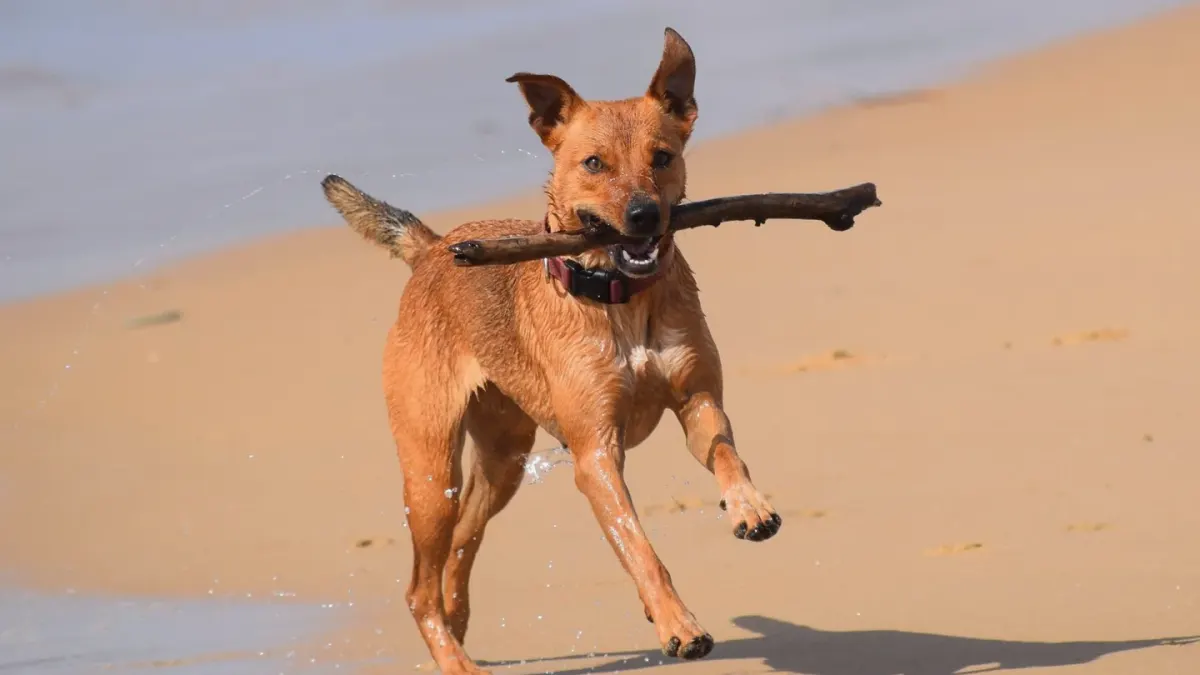
Pick the toy for the field first, the dog second, and the throw distance last. That order sounds backward until you have watched a 68-pound Labrador disappear over a hill after a low-contrast ball you can no longer track.
I saw that exact pattern go viral again this month — slow-mo long throws, sunset pasture, dog at full sprint — and the comments were all “what ball is that” instead of “is that field safe to sprint on.” As a sports-medicine clinician, I weigh what a supplement can realistically do for diet, mobility, and recovery, and I can tell you no joint chew compensates for a bad high-speed repetition pattern. Choose the object that controls speed, grip, and search time.
We had a classic open-field mismatch last spring: a 3-year-old, 54-pound Border Collie mix, lean and obsessive, playing twice weekly in a mowed soccer field with a small, slick tennis-style ball. By week three she was overshooting, skidding on dew-wet grass, then circling with her nose down for four minutes because the optic yellow had faded to dishwater gray. Her owner worried about stamina, but the observable change was mechanical — frantic braking, wide mouth chomps, drooling around frayed felt. We switched the decision fork from farther throws to a larger, high-contrast rubber disc with a soft rim, shortened throws to 30 yards, and her search time dropped under 20 seconds.
Stop buying distance, start buying brakes
Measure the field before you shop. Walk 40 paces, note dips, burrs, ponds, and fence lines. Then buy for control.
Do this in order: pick high-visibility color for grass and sky. Pick weight that flies stable in wind but lands without bounce-skip. Pick diameter your dog can grip without jaw hyperextension. Skip light foam that sails, golf-ball sizes that swallow, and hard plastic that ricochets off dry ground.
The American Veterinary Medical Association reminds owners that open sun, heat, and overexertion turn exercise into emergency fast, so plan water, shade breaks, and surface checks into every fetch session.
Short grass rewards a rolling bumper. Tall grass demands a tall, bright disc or knobby ball that sits up.
The tennis ball fail is predictable
The failed approach I see most is the parking-lot tennis ball taken to the prairie. It feels right because it is cheap, bouncy, and dogs love the fuzz.
A 5-year-old, 72-pound Golden Retriever taught me the tradeoff in one afternoon at a dry reservoir flat. He was a power chewer with worn canines, and by day 10 on fresh felt balls his owner reported yellow drool, lip-licking after carries, and a sudden refusal to drop. The abrasive cover plus sand had essentially sandpapered his mouth, and the 2.5-inch size forced a hard, repeated chomp at speed. We stopped the felt, moved to a single 3.5-inch textured natural-rubber ball used only for fetch, inspected it for tears after each session, and added a separate chew for home. His drop returned within three sessions because carrying stopped hurting.
If your dog shreds, do not buy tougher fetch toys for open fields. Buy a fetch-only toy and keep it put away. That separation preserves the shape, the visibility, and the dog’s mouth. For more on when to retire a damaged toy, see How Much Should You Spend on Dog Toys?
Fit the mouth, then fit the exercise plan
Size the toy to the muzzle. The dog should enclose it without prying the canines wide or gagging on retrieval at a run.
Choose soft-flex rubber over rigid nylon for impact. Choose solid bright orange, pink, or blue over green-yellow in green grass. Choose washable over porous felt if you train near water or mud.
The counterargument is real: some high-drive dogs only lock in for squeaky plush or real tennis feel, and switching kills motivation. I still land on safety and repetition load because open-field fetch is hundreds of identical decelerations. Enthusiasm does not protect cruciates or teeth. Keep the favorite as a reward marker, not the projectile.
VCA Hospitals frames exercise prescription around age, breed, and conditioning, which is exactly how I think about fetch volume — short conditioned intervals beat marathon throwing for mobility and recovery.
Check paws, check gums, check breathing. Then throw again.
The edge case nobody films is the senior athlete who still looks 4 from a distance. A 9-year-old, 48-pound Aussie mix came in last fall, still sprinting a hayfield twice a week, owner proud of her endurance. The tell was not limping — it was by minute 12 she started looping wide on returns and lying down with the bumper instead of delivering it. We cut throws from 60 yards to 20 yards, switched to a lightweight foam-rubber ring she could catch without jumping, moved sessions to morning cool, and added five-minute sniff breaks. Her return speed actually improved because she stopped overheating, a risk the American Kennel Club flags as especially dangerous during sustained outdoor play.
If you run a small breed in big space, scale down weight but scale up visibility, and read Exercise Ideas for Toy and Small Breeds: Vet-Guided Ways to Keep Little Dogs Fit and Safe before you extend distance.
Retire any toy with cracks, missing chunks, or embedded foxtails immediately. Rinse after field use, air-dry, store out of sun.
Your forward check is simple: can you see it at 50 yards, can your dog carry it without chomping, and can you end the game before panting turns to roaring.
Frequently asked questions
What size fetch toy is safest for open fields?
Choose a size your dog can pick up at speed without forcing the jaw wide — usually around 3 inches or larger for medium and large dogs, smaller but still non-swallowable for little breeds — and retire it if teeth compress it to a chokeable shape.
Are tennis balls okay for field fetch?
For occasional use on clean grass they work, but felt holds sand and wears teeth, and standard size is a swallow risk for large dogs. A washable rubber ball or bumper used only for fetch holds up better.
Sources
- Warm Weather Pet Safety — American Veterinary Medical Association
- Heatstroke in Dogs — American Kennel Club