On this page
You’ve got two different jobs in the yard, and they need two different anchors. A short tie-out parks a calm dog beside you while you grill. A long-line stake gives a training dog room to sniff, recall, and roam without you sprinting after them. Pick the wrong hardware for the job and you get bent metal, pulled anchors, or a loose dog.
My bias, after years in nutrition, sports medicine, and rehab, is simple: I weigh what any setup can realistically do for mobility and recovery. A stake doesn’t train a dog or condition joints. It manages risk while diet, exercise, and rehab do the real work. So buy for control and tissue safety first, freedom second.
A neighbor with a 68-pound young Lab taught me that the hard way last spring. He’d adopted him at 10 months, and by day 14 the dog had already snapped one cable clip and dragged a short screw stake 12 feet across wet sod to greet another dog. No injury, but a raw spot under the collar and a very rattled owner. He wanted a stronger stake. What he actually needed was a different system: harness attachment, swivel hardware, and an anchor rated well above the dog’s weight for that soft spring soil.
Are you parking or practicing?
Parking means you’re outside with the dog, chair nearby, tie-out under 15 feet. Practicing means a 30- to 50-foot long line for recall, decompression sniffs, or post-rehab movement on vet-approved restricted exercise.
For parking, a single heavy auger stake with a swivel head and a coated cable can work for a calm adult dog that doesn’t lunge hard. For practicing, I prefer a wider anchor — a dual-auger platform, a buried deadman-style anchor, or a stake paired with a ground sleeve — because the angle of pull changes constantly as the dog circles.
The American Veterinary Medical Association cautions against leaving tethered dogs unsupervised, and that frames everything here. No stake makes solo yard time safe. Tangles, fence jumps, collar pressure, heat, and other animals are still on you to manage.
What actually holds in dirt?
Holding power is soil plus surface area plus installation depth.
Single corkscrew stakes hold best in firm, slightly moist loam when screwed fully flush, with only the swivel eye above ground. In dry sand, loose fill, or saturated mud after rain, that same stake can corkscrew right back out under a 40-pound lunge. Clay that looks solid in August turns slick in March.
Look for welded — not bent-wire — eyes, a thick shaft, and a true swivel that spins under load. Pair it with hardware rated above your dog’s weight. A cable or biothane long line should have its working strength printed on the tag, and clips should be locking or heavy bolt-snaps rather than tiny spring clips. If you use a long line, our breakdown of Biothane vs Nylon vs Leather Long Line: Which One Actually Holds Up? helps match line material to grip and weather.
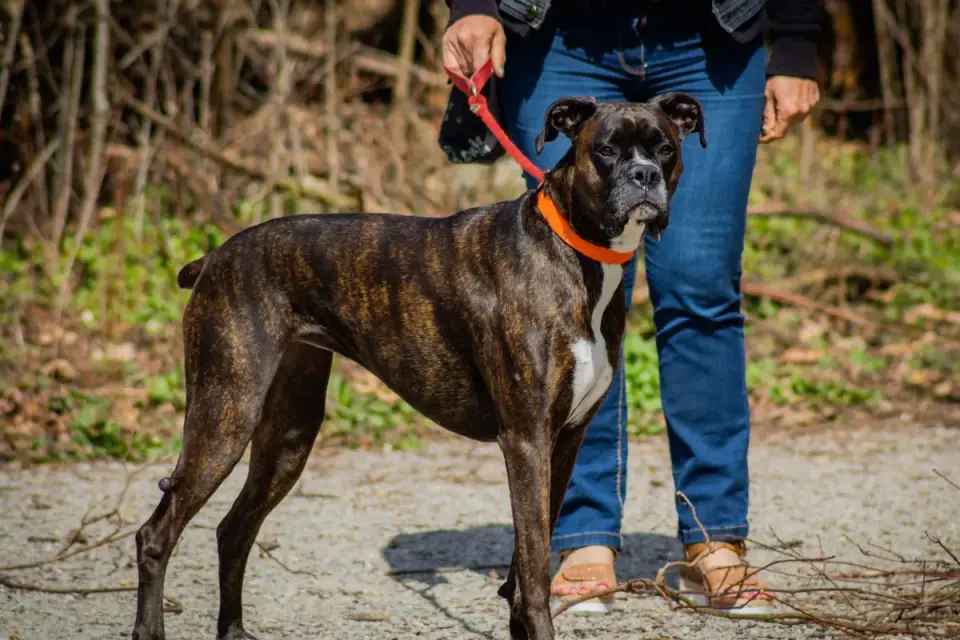
Attach to a well-fitted back-clip harness for yard sessions, never to a choke, prong, or slip collar. That one choice does more to protect necks and tracheas than any stake upgrade.
The setup that looks strong until it isn’t
A client setup I see on video a lot: 18-inch single auger, 20-foot cable, collar clip, dog left out for an hour. It looks tidy. It fails in three predictable ways.
I saw a version of it with a 4-year-old, 52-pound pit mix who was sweet but reactive to bikes. On night 3 of the new tie-out, she hit the end at a full sprint when a delivery bike passed — about a 25-foot run-up — and the eye of a cheap stake straightened open. She wasn’t lost, but she ran into the street before the owner caught her. The owner blamed the dog’s strength. The weak points were leverage, a non-swivel eye that fatigued, and collar attachment that concentrated force on the neck.
For dogs that hit the end hard, compare fixed versus stretch carefully in Bungee Leash vs. Fixed Leash for a Lunging Dog: What Actually Protects Necks and Shoulders. Stretch reduces peak force, but it also adds rebound and tangle risk around legs and posts.
Shorter is safer for parking. Keep radius clear of fences, decks, trees, and furniture legs. Use a swivel at both ends of the tie-out.
When the normal advice bends
Sometimes the yard isn’t flat suburban sod. Think rentals, rocky soil, shared fences, or a senior dog coming back from a knee injury.
One owner I advised had a 12-year-old, 34-pound beagle mix on leash-only walks for 6 weeks after a rehab plan for hind-limb weakness. She lived in a second-floor rental with a shared 20-by-30-foot gravel patch where she couldn’t sink a deep auger. Instead of forcing a stake into rock, we skipped it: a heavy patio anchor point rated for dogs, a 15-foot biothane line, a back-clip harness from our Front-Clip vs Back-Clip Dog Harness: What Actually Stops the Pulling guide, and a chair-side setup where the owner stayed within arm’s reach.
That bend matters. In rock, concrete-adjacent yards, or frozen ground, don’t upsize the hammer. Change the anchor class or stay hands-on with the leash.
The ASPCA general dog-care guidance reinforces the same baseline: shelter, water, supervision, and safe confinement matter more than any single product.
So which approach actually earns it? If you’re with your dog and need hands-free parking, use a fully seated welded auger or platform anchor, swivel hardware, harness attachment, and short radius. If you’re training distance, use a longer line on a wider anchor, gloves for grip burns, and active supervision.
No stake replaces a fence or a person.
Frequently asked questions
Can I leave my dog on a yard stake while I go inside?
No. Use stakes only when you can see and reach your dog. Dogs can tangle, overheat, injure their necks, or pull free when unsupervised.
Should the tie-out clip to a collar or harness?
Clip to a well-fitted harness for yard tie-outs and long lines. Collars concentrate force on the neck, especially if the dog hits the end at speed.
Why does my stake keep pulling out?
Usually soft, sandy, wet, or disturbed soil plus too little surface area. Try a wider dual-auger or platform anchor, reinstall fully flush in firmer ground, shorten the radius, and check that swivels spin freely.
Sources
- Dog Care — American Veterinary Medical Association
- General Dog Care — ASPCA