
If your For You feed is full of narrow-headed dogs ducking out of flat collars in one quick reverse, you face the same fork every escape-prone owner faces: crank a flat collar tighter every walk or switch to limited-slip control.
Pick limited-slip if your dog slips more than she pulls. Pick a different tool if your dog chokes herself forward on leash despite training. That one decision prevents most misuse I see discussed online.
Philip in Albany learned this with Amelie, his 5-year-old spayed female Dachshund. She slipped her flat collar twice in three weeks by stopping, dipping her head, and backing up on a sidewalk. He was weighing a tighter buckle collar against a martingale, and what changed the choice was fit: a flat collar snug enough to stop Amelie had to stay tight all day, while a martingale could rest loose and snug only on leash tension.
Decide in 30 seconds: slip-out or pull-through?
Choose a martingale for the slip-out pattern. Head narrower than neck, neck narrower than skull behind the ears, panic back-up when startled, Houdini wiggle at crosswalks. Greyhounds, Whippets, Salukis, Dachshunds, and many mixes fit this shape.
The American Kennel Club describes martingale collars as limited-slip designs that tighten a set amount under tension and then release, which supports safer everyday wear for these shapes when fitted to prevent slipping without constant pressure. VCA Hospitals reminds owners that any collar left too tight or used for tie-out may still irritate skin and trachea, which is why the stop point matters more than the fabric.
Do not choose a martingale to stop hard pulling, lunging, or leash reactivity alone. It will not teach loose-leash walking, and repeated full-tight hits may still cough or gag a persistent puller. For that pattern, pair a well-fit flat collar or harness for daily wear with training, and read our flat collar basics and leash choice for lungers before you buy anything wider.
Measure first. Buy second.
Size the loop so it only snugs
Set the collar up off the dog. A martingale has two loops: the large collar loop that goes around the neck, and the small control loop with the D-ring where the leash clips. Pull the control loop taut. The two sliders where fabric meets hardware should almost touch but leave about two finger-widths of travel. That gap is your safety stop.
Now put it on and adjust. Position it high, just behind the ears and jaw, not hanging low on the mid-neck where tracheal pressure concentrates. With no leash tension, you should slide two fingers flat under the collar all the way around. Clip a leash on, pull gently to mimic a back-up, and check again: the collar should snug evenly so it cannot pass over the ears, but you should still slip one fingertip under it at full tighten.
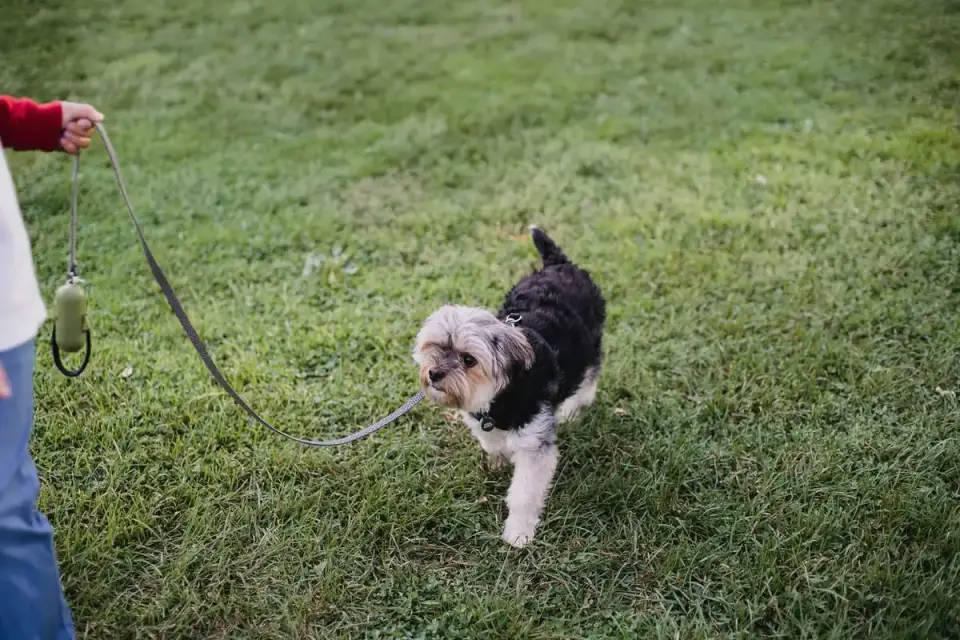
Use chain-and-nylon for smooth release if coat tangles easily, or all-fabric if noise sensitivity is an issue. Skip extra-wide, heavy hardware for dogs under about 15 pounds unless the maker specifically sizes it for small necks, and never add a second leash to the control loop plus a tie-out to the same ring.
Vets often see rub sores behind the ears from collars worn 24/7, not from walks. Take the martingale off indoors and at the dog park, check for dampness or grit under the loops after rain, and re-check fit every two weeks during weight change or heavy shedding. The preventive evidence here is thin — we have fitting consensus and day-to-day practice, not randomized trials on escape rates — so treat fit checks as maintenance, not a one-time task.
Walk it, wash it, know when to switch
Clip, test, go. Attach the leash only to the D-ring on the control loop. Do a three-second porch test: cue a gentle back-up, feel the snug, then release and confirm it loosens on its own. If it sticks tight, rinse grit from the sliders and re-adjust.
Keep daily walks boring in a good way. Use a 4- to 6-foot fixed leash, keep slack when you can, and reward check-ins instead of popping the collar. For long-line sniff walks, clip the long line to a harness and leave the martingale as ID backup; see our breakdown of long-line materials for why that separation protects necks and shoulders.
Switch tools if coughing, pawing at the collar, hair loss around the neck, or continued full-force lunging persists after two weeks of consistent training. Those signs mean the job changed from preventing slip-outs to managing airway risk or behavior, and a well-fit harness plus a trainer visit may help maintain comfort while you work on the pull pattern.
Bottom line: for the true slip-out dog, a correctly stopped martingale supports a loose resting fit with just enough tightening to stay on — and for the hard puller, it is the wrong fix.
Frequently asked questions
Can a dog wear a martingale all day?
Take it off indoors. It should rest loose on walks and snug only under leash tension, and unsupervised wear raises snag risk.
How tight should a martingale get when it tightens?
Tight enough that it cannot slide over the ears when you mimic a back-up, but loose enough to still slip one fingertip underneath at full pull.
Sources
- American Kennel Club Homepage — American Kennel Club
- Pet Health Resources — VCA Hospitals