
Your For You page says buy the wobble board and your dog will move like an athlete by Friday. My sports-medicine brain says slower: pick the right unstable surface first, then earn the wobble in 2-minute reps.
Last week the decision looked like this in my living room setup: a 4-year-old, 48-pound mixed-breed who hikes on weekends but slips on hardwood and skips the last two stairs at night. Her owner was weighing a $40 wobble board with a high rim versus a $25 inflatable balance disc she already owned for her own workouts. By day 10 of short licking-mat sessions, the marker that changed was stance time — she could stand square on the deflated disc for 20 seconds without stepping off for cheese. That concrete fork — big tippy board versus small forgiving disc — is where every home program should start.
Your starter checklist — do this before you add wobble:
- Vet clearance first if age 8+, post-surgery, knuckling, or crying on stairs
- Grip first: yoga mat under everything, nails trimmed, no socks on tile
- Disc before board for beginners, seniors, and dogs under 20 pounds
- 2-3 minutes total, 20-30 second holds, 4-5 days per week
- Pay for stillness, not tricks — reward four paws planted and weight shifting
- Stop for panting, sitting down fast, whale eye, or front-leg trembling that does not resolve in 60 seconds
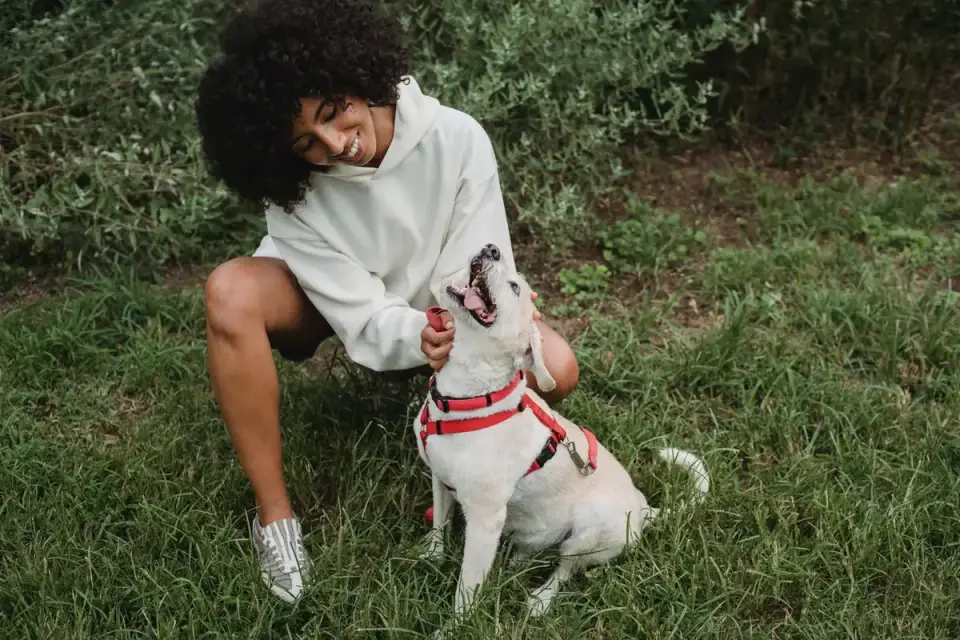
Wobble board or balance disc — which one should you actually start on?
Think diet, mobility, and recovery as one budget. I weigh what a supplement can realistically do for diet, mobility, and recovery against what two minutes of controlled standing can do, and for most stable adult dogs the standing wins early because it trains the system you cannot feed: proprioception and trunk co-contraction.
A balance disc is a half-deflated air cushion. It moves a little in every direction and it forgives a mistake. A wobble board is a rigid platform on a rounded base. It tips farther, faster, and it punishes bad paw placement. For home use, start 90% of dogs on the disc.
Set the disc almost flat for week one. Lure the dog on with food at nose height — not overhead, which arches the back. Pay for stepping on, then for standing square for 3 seconds, then 10, then 20. Add tiny weight shifts: nose 2 inches left, then right, then a slow step of your own around the dog so she tracks you. That is the whole exercise.
Move to the board only when she can do three 30-second stands on the disc without stepping off. Put the board on its lowest tilt setting, against a wall, with you kneeling in front. One paw at a time is fine.
This pairs well with low-impact conditioning ideas in Exercise Ideas for Toy and Small Breeds if you live with short legs and a fast metabolism.
Can 5 minutes really build strength, or is this just TikTok core?
Short answer: short and boring builds control, not bulk. That still matters for stairs, car jumps, and slippery floors.
The failed approach I see most: the owner who tried to rush it. One composite case from rehab rechecks — a 6-year-old, 72-pound Lab with early stiffness who got a wobble board for Christmas. The plan was 15 minutes straight while dinner cooked, luring spins and sit-to-stands on a fully inflated disc by three weeks in. The observable change was not strength; it was avoidance. By day 12 he circled the board, licked his carpus, and sat after 40 seconds. We scrapped the marathon, went back to a mat on the floor, then 20-second stands with a snuffle mat, and his willingness returned before his endurance did.
That tradeoff is the point. Unstable-surface work fatigues stabilizers fast. More time just buys compensation — elbows out, back roached, weight dumped forward. Keep total time under 5 minutes, rest 1, and progress range of motion before duration. Front paws on a low book while rears stay on the floor counts. Side-stepping over a broomstick counts. You do not need circus tricks.
If your dog is already arthritic, read Swimming vs Walking for an Arthritic Dog before you add instability, and keep land sessions even shorter on swim days.
Where do joint ingredients fit when the work gets wobbly?
Exercise loads the joint; nutrition supports the tissues around that load. I ground an integrative claim in the nutritional evidence, and here the evidence is narrow and ingredient-specific.
Chondroitin research is often described in Frontiers in Veterinary Science as work that “supports healthy synovial fluid homeostasis” — useful context for why steady, low-impact movement plus a complete diet matters for lubrication, not proof that a chew fixes wobble.
That single sentence is a deliberately short reality check.
Glucosamine HCl has laboratory work cited as “prevent experimentally induced cartilage degradation in vitro” in the Journal of Veterinary Medical Science, which may help support whole-patient joint health as part of a balanced plan, not as a performance shortcut.
Green-lipped mussel data are even more preliminary, with one report in Nutrients noting that “BMO, GMO, and KO all alleviated paw swelling in rats and reduced serum levels of rheumatoid factor (RF), anti-cyclic citrullinated peptide (anti-CCP) antibody, and pro-inflammatory cytokines such as TNF-α and IL-17.” Interesting biology, not a reason to push a sore dog harder on the board.
My take: feed a complete adult diet first, keep body condition lean enough to see a waist, then — if you and your vet want a joint chew — look for named actives with real milligrams on the label. Weigh what that chew can realistically do: it may help support normal mobility and recovery alongside training, it does not replace weight control, strength work, or pain care.
For context on total weekly load, see How Far Can a Dog Walk or Hike in a Day?.
The edge case that changes the plan is the tiny senior who looks athletic. Think a 11-year-old, 14-pound terrier mix who still bosses a balance disc for treats but coughs at night and splays her rear feet by week two of a new program. The owner wanted harder board work because the videos looked easy. The smarter application was easier: back to floor stands, disc fully deflated, 15-second reps, plus a vet check for airway, vision, and hind-limb proprioception before any elevation. For toy breeds and seniors, instability magnifies every hidden deficit, so progress means lowering the challenge until form is perfect again.
Forward-looking bottom line: keep the disc, skip the fancy board until those 30-second stands are boring, and let food, lean weight, and short reps do the quiet work the algorithm will never film.
Frequently asked questions
How often should I do wobble board exercises for dogs at home?
For most healthy adult dogs, 4-5 days per week for 2-5 minutes total, with 20-30 second stands and equal rest. Stop if form breaks, panting spikes, or soreness lasts past the next morning.
Is a wobble board or balance disc better for beginners?
Start with a balance disc, nearly deflated, on a non-slip mat. Move to a wobble board only after your dog can hold three 30-second disc stands without stepping off.
When should I skip balance work and call my vet?
Skip it and call for knuckling, sudden lameness, crying, swelling, post-surgical restrictions, unexplained weight loss, or dogs over 8 starting a new program without clearance.
Sources
- Synovial fluid homeostasis study — Frontiers in Veterinary Science
- Cartilage degradation in vitro study — Journal of Veterinary Medical Science
- BMO GMO KO paw swelling study — Nutrients