On this page
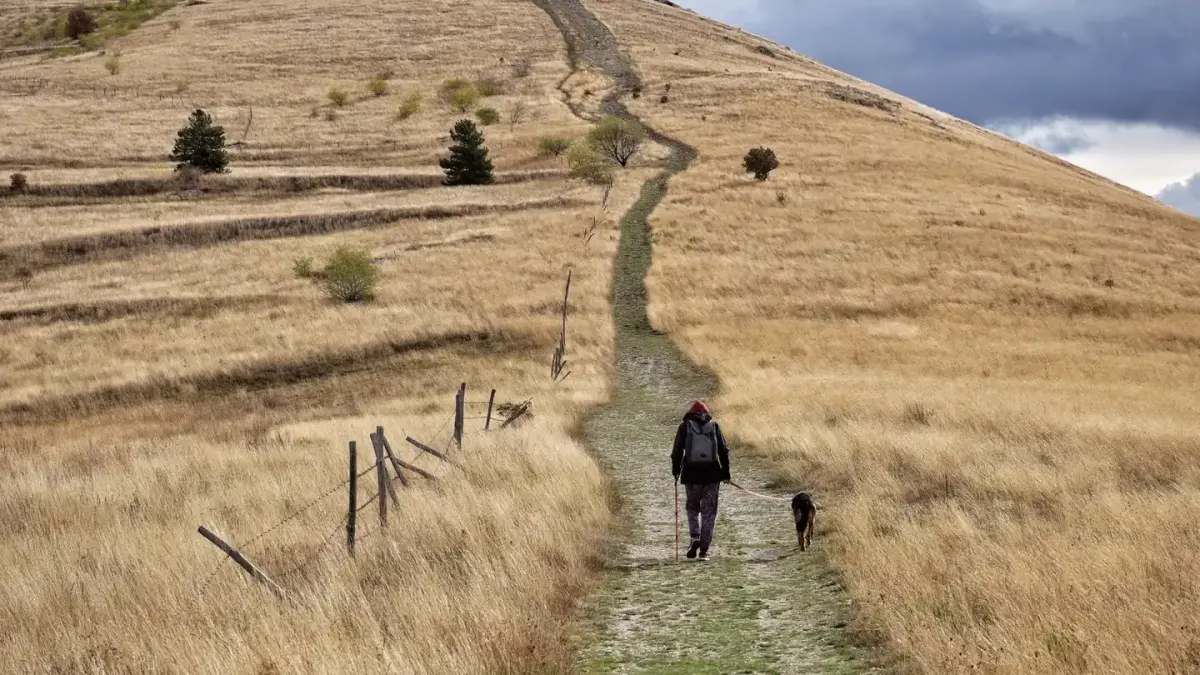
Every few months a version of the same clip resurfaces: a dog owner strapping on a pack, captioning it “first 10-miler of the season,” and a comment section split between awe and concern for the dog trailing a step behind. The trend isn’t wrong that dogs can cover serious ground. It’s wrong to treat one dog’s mileage as a template for every dog on the trail.
As a veterinary nutritionist and sports-medicine specialist, I get some version of this question from clients before nearly every hiking season: how far is too far? The honest answer is that distance itself isn’t the variable that matters most. What matters is what’s happening in the dog’s muscles, joints, and airway while covering it.
Before the Trailhead: What “Conditioned” Actually Means
Conditioning is the single biggest lever on a dog’s hiking ceiling, and it isn’t the same as being generally active. A dog that plays fetch in the backyard daily hasn’t necessarily built the tendon and cardiovascular endurance for sustained, uneven-terrain walking over hours.
Building real conditioning means gradually loading connective tissue so it adapts rather than simply fatigues. Start an untrained adult dog at 1-2 miles on flat ground, and add distance in small increments over several weeks rather than jumping straight to a weekend goal. For toy and small breeds, that base distance and the increments both need to be smaller, since their joints and stride mechanics are working against a much higher relative workload per mile than a larger dog’s.
Puppies deserve a separate note here. Growth plates in most breeds don’t finish closing until somewhere between 12 and 18 months, with large and giant breeds often on the later end. Repetitive, high-impact distance work before that window closes is a real risk factor for orthopedic injury, so puppy hikes should stay short, low-impact, and terrain-gentle rather than mileage-driven.
How Far Is Reasonable, by Build and Age
Once conditioning is in place, breed structure sets the next boundary. Large, athletic working and sporting breeds with sound joints can often handle 10-15 miles on moderate terrain when properly built up. Medium breeds with good conditioning tend to top out closer to 5-10 miles. Small and toy breeds are working harder per stride than their size suggests, and 1-3 miles with extra rest breaks is a more realistic ceiling even when fit.
Age changes the equation in both directions. Very young dogs are limited by developing joints, and older dogs are limited by osteoarthritis, reduced cardiovascular reserve, and slower recovery between efforts, even when they show plenty of enthusiasm at the start of a hike. A senior dog’s willingness to keep walking is not a reliable stopping signal on its own.
This is short but worth stating plainly: no mileage chart replaces knowing your own dog’s normal gait and effort level well enough to notice a change in either.
Heat, Airway Anatomy, and When Distance Stops Mattering
Breed structure also determines how well a dog can shed heat, and that can matter more than distance on a warm day. Brachycephalic dogs — bulldogs, pugs, and similar flat-faced breeds — have less efficient airway cooling and are consistently over-represented in cases of exertional heat-related illness, developing hyperthermia faster than dogs with longer muzzles under the same heat load, according to a study on PMC (National Library of Medicine): heatstroke and brachycephalic dogs. For these breeds, a hot afternoon can turn a modest half-mile into an unsafe amount of exertion.
Heatstroke isn’t limited to brachycephalic breeds, though they carry the highest risk. Any dog exercising in heat and humidity is vulnerable, and according to Cornell University College of Veterinary Medicine, it is a true medical emergency once body temperature climbs beyond the dog’s ability to dissipate it through panting. Hiking distance goals should always defer to ambient temperature, humidity, and shade availability rather than the other way around.
Mid-Hike Signs It’s Time to Turn Around
A useful rule for any breed: distance is a plan, not a promise, and the dog’s behavior overrides the plan. Lagging behind on a leash the dog normally pulls against, panting that doesn’t slow during a rest stop, reluctance to jump onto a rock or log, or a stumble on flat ground are all reasonable points to stop and head back rather than finish the loop.
Bringing water and offering it regularly, planning shaded rest stops, and checking paw pads for wear on rough terrain all extend how far a given dog can comfortably go on a given day. None of these substitute for reading the dog’s actual effort level.
After the Trail: Recovery and Joint Support
What happens after a long hike matters almost as much as the hike itself. Muscles and connective tissue that were asked to work harder than usual need time and, in some dogs, targeted support to recover well. Glucosamine and chondroitin are among the most studied joint-support ingredients for dogs; chondroitin has been shown to Frontiers in Veterinary Science: support healthy synovial fluid homeostasis, and glucosamine HCl has been studied for its ability to help Journal of Veterinary Medical Science: prevent experimentally induced cartilage degradation in vitro. Green-lipped mussel is another ingredient worth knowing: research summarized in Nutrients found mussel-derived compounds reduced paw swelling and lowered inflammatory markers in animal models, which is part of why it’s a common addition to joint formulas aimed at active or aging dogs.
None of these ingredients turn an unconditioned dog into a trail-ready one, and none replace a gradual training plan. What they may offer is a bit of extra support for joints already carrying real mileage — a reasonable conversation to have with your vet if your dog hikes regularly, is aging into arthritis, or is recovering from an unusually demanding outing. If your dog also tends to get an upset stomach from new trail treats, it’s worth reading up on how much fiber is too much for a dog before packing snacks for the next hike, and if a big outing tends to leave your dog wired rather than tired that evening, chamomile vs. L-tryptophan for calming dogs is worth a look.
The short version: match the hike to the dog you actually have, not the one in the video. Build distance gradually, respect breed and age limits, watch the dog rather than the odometer, and treat heat as a hard stop rather than a suggestion. Do that, and the mileage that’s actually safe for your dog will become obvious well before you need a chart to tell you.
Frequently asked questions
How far can a healthy adult dog hike in one day?
It depends heavily on conditioning. An unconditioned adult dog does well with 1-3 miles, while a dog that has been built up gradually over weeks, on easy terrain in mild weather, can often manage 10 miles or more. Very few dogs, even fit ones, should be pushed to that upper range on a first outing.
Is 5 miles too far for a dog to hike?
For most conditioned medium and large breeds, 5 miles on moderate terrain is a reasonable day hike. For an unconditioned dog, a toy breed, a senior, or a flat-faced breed, 5 miles can be excessive and worth splitting into a shorter, slower outing.
What are the first signs a dog has hiked too far?
Watch for lagging behind, reluctance to keep moving, excessive panting that doesn't settle during rest, stumbling, or reluctance to jump or climb. Any of these is a reasonable point to turn back rather than push toward a mileage goal.
Do joint supplements help dogs recover from long hikes?
Glucosamine and chondroitin are among the most studied joint-support ingredients for dogs, and green-lipped mussel is another well-researched option; none of them substitute for proper conditioning, but they may support joint comfort in dogs with an active or aging joint load. Ask your vet before starting one, especially for a dog with existing orthopedic disease.
Sources
- Chondroitin sulfate and synovial fluid homeostasis in joint health — Frontiers in Veterinary Science
- Glucosamine HCl and cartilage degradation: a review — Journal of Veterinary Medical Science
- Green-lipped mussel extract and joint inflammation markers — Nutrients
- Heatstroke: A Medical Emergency — Cornell University College of Veterinary Medicine
- Heatstroke and brachycephalic dogs – is there an increased risk? — PMC (National Library of Medicine)