How to Safely Scissor a Dog's Face
Scissoring a dog's face safely comes down to one rule most owners skip — tiny, blocked snips with blunt tips, never a straight cut toward the eye.

On this page
The first time I told an owner to put down her regular sewing shears and go buy actual blunt-tip grooming scissors, she looked at me like I was being precious about it. Her dog was a twelve-pound Shih Tzu named Biscuit, four years old, whose bangs had grown long enough that he was headbutting the coffee table because he genuinely couldn’t see it. She’d been trimming his face herself for a year with whatever scissors were in the kitchen drawer, and it had mostly gone fine — until the week before, when Biscuit jerked his head at the vacuum cleaner mid-snip and she nicked his eyelid. It wasn’t a dramatic injury. A little redness, some blinking, no corneal damage when I checked him. But it was exactly the kind of moment that shows up over and over in the PubMed case review of grooming-related eye injuries in dogs: not negligence, just a sharp-pointed tool, a moving animal, and a half-second of bad timing.
The decision fork: sharp-point habit vs. blunt-tip discipline
Most owners don’t fail at scissoring a dog’s face because they lack coordination. They fail because they’re using the wrong tool with the wrong motion. Standard sewing or craft scissors have pointed tips built for straight-line cuts on fabric that doesn’t flinch. A dog’s face is the opposite of that: it’s mobile, it’s close to the eyes, and it moves without warning. The fork isn’t “can you trim at home” — plenty of owners do this safely for years. It’s whether you’re set up with rounded, blunt-tip shears and a habit of cutting parallel to the face instead of pointed at it. Get that piece right and the rest is patience.
Blunt-tip, or “safety-tip,” scissors have rounded ends specifically so an unexpected head jerk turns into a bump instead of a puncture. Groomer-facing safety literature consistently recommends them for the eye, ear, and muzzle region for exactly this reason — a PetEdge safety guide for professional groomers lists rounded-tip shears as a baseline precaution around sensitive areas, not an optional upgrade.
What actually goes wrong around the eyes
The data on this is more specific than most owners expect. A retrospective case review of 161 grooming-related ocular injuries in dogs, published in PubMed, found corneal ulceration was the most common injury type, followed by conjunctivitis, eyelid lacerations, and subconjunctival hemorrhage. That tells you where the real risk concentrates: not the muzzle, not the cheeks, but the tissue immediately surrounding the eye, where a scissor tip or a stray hair clipping can do outsized damage relative to how small the cut looks.
That’s why the technique that actually matters is boring: pull the hair away from the eye first, block the falling clippings with your free hand, and cut with the blades parallel to the face rather than pointed toward it. If hair is already touching the eye, a fine-toothed comb to lift it away before you cut beats trying to snip close and hope the dog holds still.
Building the actual routine that works
Here’s the sequence I walk owners through, and it holds for most flat-faced or long-coated breeds — Shih Tzus, Maltese, Poodles, Cocker Spaniels, anything where facial hair grows into the eyes:
- Brush the face fully tangle-free before scissors ever come out. Matted hair pulls, and a dog that flinches from a tug is a dog that moves mid-snip.
- Trim the hair between the eyes first, working outward, in small sections rather than one long pass.
- Cut only two or three hairs at a time near the eye itself. Leaving roughly a quarter inch of length keeps hair off the eye without getting close enough to the skin to risk it.
- Steer around whiskers on the muzzle, cheeks, above the eyes, and chin. Trim the fur around them, not the whiskers themselves — whiskers are sensory structures, not just hair.
- Stop and reposition, don’t force a cut, any time the dog shifts its head. The scissors wait; the dog doesn’t have to.
I’ll be honest that the evidence on how much whisker-trimming actually affects a dog day-to-day is thin — it’s a reasonable precaution rooted in what we know about vibrissae as tactile sensory organs, not a claim I can back with a dosed clinical trial. Where the evidence is genuinely strong is the eye-injury pattern itself, and that’s worth taking seriously even when the trim looks routine.
One of the dogs I still think about was a ten-year-old Cocker Spaniel named Wallace, brought in by an owner who’d been scissoring his face herself since he was a puppy without incident. What changed wasn’t her technique — it was Wallace. He’d developed mild cataracts that year, and his depth perception around fast hand movement near his face had quietly gotten worse. She hadn’t clocked it because his day-to-day behavior looked normal. It only showed up as a slightly delayed flinch response during a trim, which she noticed and stopped for. That’s the piece I try to get across: the technique doesn’t stay static just because the dog does. An aging dog, a dog on new medication, a dog with early vision changes — all of those change how much margin you actually have, even if the scissors and the routine haven’t changed at all.
Where a professional earns the appointment
Not every face trim needs a professional groomer, but some situations tip the math. A dog that won’t hold still despite tooth-brushing-style desensitization work, heavily matted facial hair that needs to come out close to the skin, or a breed with a lot of loose facial skin where the margin for error around folds is smaller — those are reasonable moments to hand it off. If you’re weighing that tradeoff more broadly, the calculus is close to the one we laid out in how to actually decide between at-home grooming and a professional groomer: it comes down to your dog’s tolerance for restraint, not your skill with the scissors.
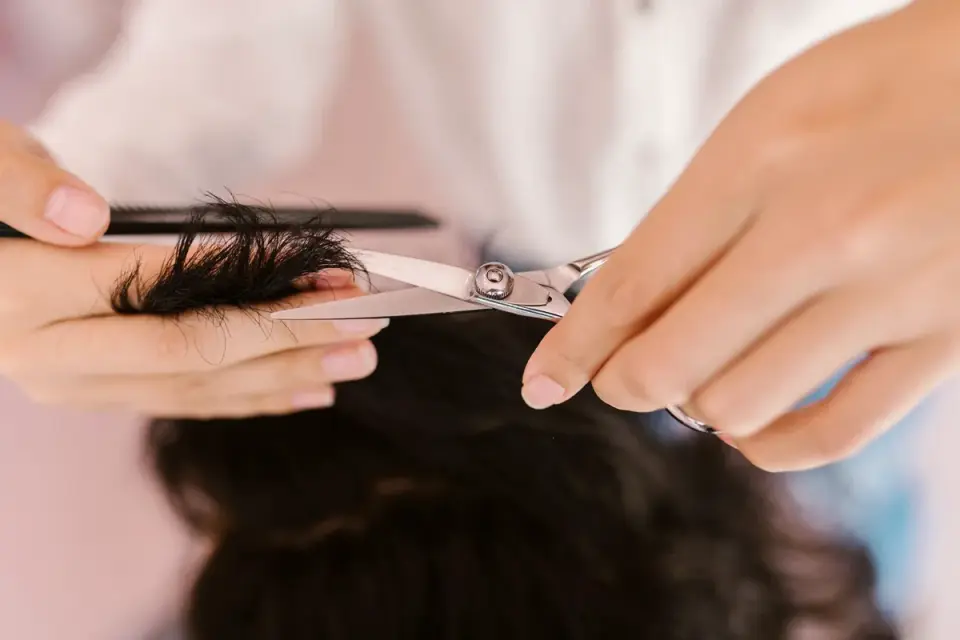
The rest of the face is genuinely lower-stakes. Cheeks, chin, and the bridge of the muzzle give you more room to work slowly and correct a crooked line. If you’re also keeping up with nail maintenance on the same schedule, how often you should trim a dog’s nails is a useful adjacent routine to have dialed in, since a squirmy dog on trim day is usually squirmy for both.
Where I land
Scissoring a dog’s face at home is a reasonable, ordinary thing to do — the injury data doesn’t say don’t do this, it says be specific about how you do it. Buy blunt-tip scissors if you don’t already own a pair; they cost little and remove an entire category of accident. Cut small sections, parallel to the face, with your hand blocking falling hair from the eye. Reassess a dog whose tolerance or vision has changed, even if nothing about your routine has. And if a dog won’t settle no matter how patient you are, that’s not a failure on your part — it’s a normal reason to book fifteen minutes with a groomer instead of forcing it.
Bottom line: the scissors aren’t the risky part of this — pointed tips and rushed technique are, and both are fixable before you ever get near the dog’s face.
Frequently asked questions
What kind of scissors are safest for trimming a dog's face?
Blunt-tip, rounded-end "safety" grooming scissors are the safest choice for the eye, ear, and muzzle area, since a sudden head movement is more likely to result in a bump than a puncture.
How much hair should you leave near a dog's eyes?
Roughly a quarter inch is a common target — short enough to keep hair from irritating the eye, but with enough margin that you're not cutting close to the skin itself.
Is trimming a dog's whiskers during a face trim harmful?
The evidence on day-to-day impact is limited, but whiskers are sensory structures, so most groomers trim the fur around them rather than cutting the whiskers themselves as a precaution.