Play Bow or Aggression? Reading Dog-to-Dog Signals
The tell isn't the noise level, it's whether both dogs keep choosing to come back for more.

On this page
Every dog owner has had the moment: two dogs are tangled up, growling, teeth bared, moving fast, and you freeze with your hand halfway to the leash. Is that play, or do you need to step in right now?
I’ve spent enough afternoons at the dog park and enough exam-room conversations with worried owners to know that the sound of a dog scuffle scares people far more than it should, and the quiet of a real fight is what actually catches people off guard. Noise is a terrible predictor. What you want to watch instead is rhythm — does the interaction keep restarting, or does it keep escalating?
The pause test beats the noise test
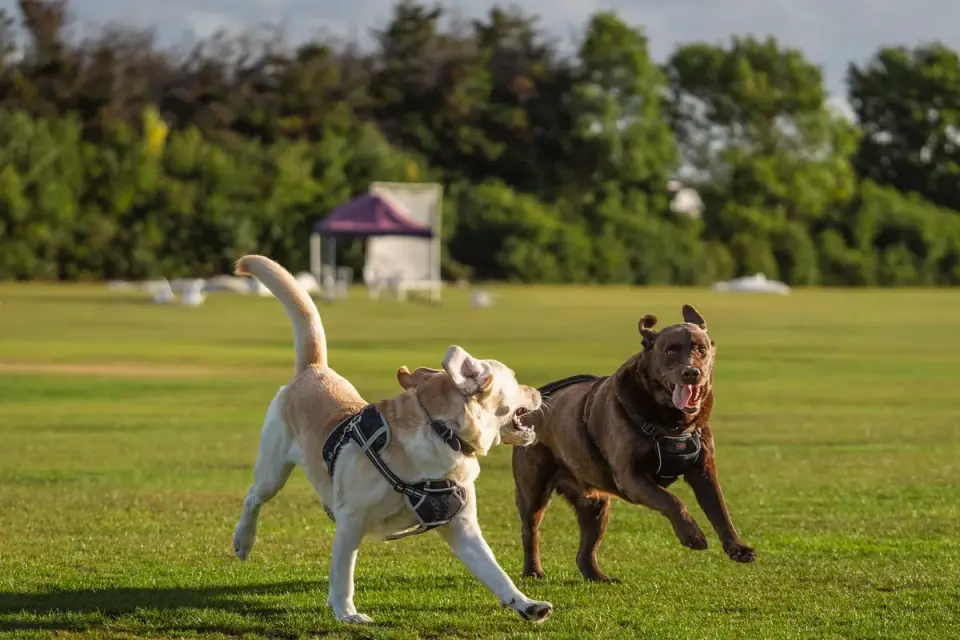
If you only remember one thing, make it this: playing dogs interrupt themselves. Watch for a few seconds after any dramatic-looking moment — a body slam, a mouth around a neck, a chase that ends in a pile-up. In real play, both dogs shake it off, reset, and often one of them offers a American Kennel Club: play bow — front legs down, chest low, rear end in the air — as a kind of punctuation mark that says that was fun, again? Loose, bouncy movement, a soft C-curve to the body, and an open, relaxed mouth (sometimes called a “play face”) round out the picture.
A genuine fight doesn’t pause on its own. The pace holds or climbs, bodies stiffen and go vertical instead of loose and low, tails go rigid or tuck, and the growls drop lower and stop sounding exaggerated. One dog stops offering to switch positions and just keeps pressing the advantage.
Role reversal is the detail most people miss
This is the part that surprised me most when I actually dug into the research on it: play isn’t as evenly split as the old “50 rule” suggests. A ScienceDirect: study on cooperation and competition in dyadic dog play found that larger, more socially confident dogs “win” more often than they lose during play and rarely self-handicap, while their partner tolerates a lopsided game because the relationship as a whole still feels safe. What matters isn’t a perfect 50-50 split of who’s on top — it’s whether any switching happens at all, and whether the smaller or less dominant dog keeps voluntarily going back in for more. A dog who is truly done will start avoiding, not initiating.
One case still sticks with me. A client brought in her two dogs, a five-year-old Lab mix named Otis and a new nine-month-old foster, a lanky Shepherd-mix puppy named Juniper, because the wrestling looked “too rough” to her — Otis kept pinning Juniper to the living room floor and standing over her. I watched video from her phone with her, frame by frame. Juniper kept trotting back over, tail loose, initiating the next round within seconds of getting up. Otis, for his part, would flop onto his back mid-chase and let her get a mouthful of his ear, something a genuinely aggressive dog rarely does. What looked lopsided on the surface was actually a fairly typical big-dog, young-dog dynamic — asymmetrical, but consensual on both ends. The tell wasn’t who was winning; it was that Juniper never once hesitated at the door of that living room.
Vocalization is the least reliable signal you have
Growls, snarls, and even loud snapping sounds happen constantly in normal dog play, and they scare owners more than almost anything else in the interaction. On their own, they tell you very little. What matters is context: is the growl paired with a loose body and a returning dog, or with a stiff body and a dog trying to create distance? The American Veterinary Society of Animal Behavior has repeatedly emphasized reading body language as a whole picture rather than any single cue in isolation, which is exactly why sound-only judgment gets people into trouble — both the owner who panics over a normal wrestling match and the owner who lets a real fight run too long because “they’re always loud like that.”
I think about this every time I talk to a family who just adopted a second dog. The instinct is to referee every growl. In my experience, that actually backfires — dogs need the freedom to self-correct with a growl or a snap without a person diving in every time, or they lose the ability to communicate discomfort at all, which is its own long-term problem. The exception is real intensity: a growl that’s low, sustained, and paired with stillness rather than movement is different from the quick, high-pitched growl-bark combo you hear mid-chase.
When to actually step in
You don’t need a perfect read every time — you need a threshold for interrupting. Break it up if you see any of these together: a dog trying repeatedly to get away and being followed and cornered, teeth making contact with real pressure rather than an open, inhibited mouth, hackles up along the whole spine rather than just a small patch near the shoulders, or one dog going stiff and quiet after being loud and loose a moment before. That sudden shift from noisy-and-bouncy to silent-and-still is one of the more reliable warning signs, not the noise itself.
If you do need to separate two dogs, avoid grabbing collars or reaching into the middle of it — a startle-and-redirect, like a loud clap, a body block, or tossing something to break visual focus, is safer for you and usually enough to reset the moment. For dogs who consistently struggle to settle after normal play, or who seem to escalate rather than de-escalate with the same playmate over multiple sessions, that’s less a body-language question and more a training or temperament one, and it’s worth a conversation with a trainer experienced in dog-dog introductions or your veterinarian, especially if either dog also shows growling around handling or touch at home.

Owners bringing home a new dog or puppy often ask me this same question in the first few weeks, right around the time they’re also working through a potty-training schedule and figuring out whether their breed and living situation is a good match for the dog they actually have, not the one they pictured. Reading play accurately is a skill that gets easier with reps, and it’s worth building early, because two dogs who play well together for years usually started with a few sessions where a person was watching closely and knew what to look for.
The short version
Play and fighting can look and sound almost identical for a few seconds at a time. The difference shows up over the whole interaction: does it pause and restart on its own, does the “losing” dog keep coming back, and does the body stay loose or go rigid. Trust the pattern over any single growl, bark, or bite-shake, and step in on the shift from loose-and-vocal to stiff-and-silent rather than waiting for blood.
Frequently asked questions
Is growling always a bad sign between playing dogs?
No. Growling is common during normal play and means little on its own — what matters is whether it's paired with a loose, bouncy body that keeps returning to play, or a stiff, still body trying to create distance.
What's the single fastest way to tell play from a fight?
Watch for a natural pause. Playing dogs interrupt themselves, shake off, and often re-invite play with a bow. A real fight tends to hold its pace or escalate without a voluntary break.
Should I separate my dogs every time one yelps?
Not necessarily. In normal play, a yelp usually causes the other dog to back off on its own. Step in if that self-correction doesn't happen, or if you see sustained pressure, cornering, or a sudden shift from loose to rigid.
Sources
- Are Dogs Playing or Fighting? How to Tell the Difference — American Kennel Club
- Investigating the function of play bows in adult pet dogs (Canis lupus familiaris) — ScienceDirect
- Position Statements and Handouts — American Veterinary Society of Animal Behavior