On this page
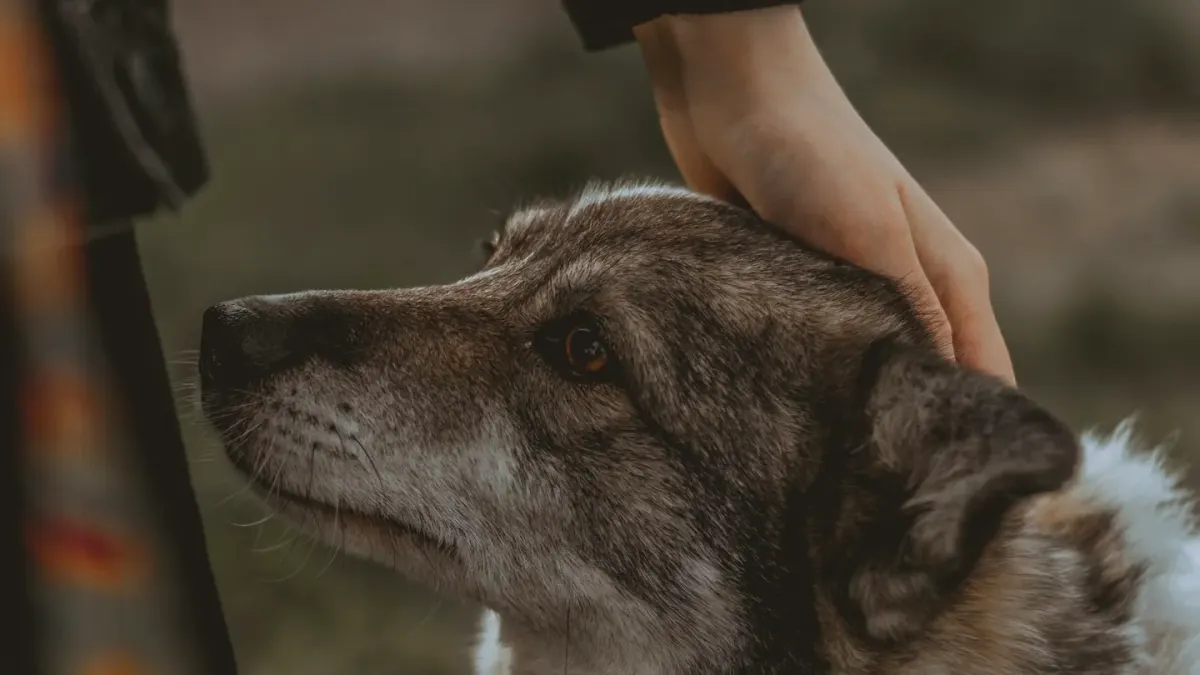
You’ve probably seen the clip: someone reaches down to pet their dog, the dog leans in, and then — a low, rumbling growl. The caption is some version of “he loves me but also hates me?” It’s one of those behaviors that feels personal, like a betrayal from an animal you’ve only ever been kind to. It isn’t personal. A growl is your dog talking, and once you know what it’s usually saying, the fix gets a lot clearer.
A growl is information, not an insult
Growling sits fairly high on a dog’s warning system. Before most dogs growl, they’ve already tried quieter signals — going still, turning the head away, a quick lip-lick, showing the whites of the eyes. The growl is what’s left when those softer “please stop” cues didn’t land. The ASPCA lists growling and snarling among the warning behaviors dogs use before a bite, which is exactly why the growl is useful to you: it’s an early-warning system doing its job.
That’s also why punishing it backfires. Scold or correct a dog for growling and you might teach him to stop growling — but you haven’t changed how he feels about being touched. You’ve deleted the warning, not the discomfort. Plenty of “bit with no warning” stories start with an owner who trained the growl out first. The American Veterinary Society of Animal Behavior is blunt on the broader point: based on current evidence, only reward-based methods are recommended for training and behavior problems, because aversive corrections tend to increase fear and aggression rather than resolve them. Let the growl keep talking. Your job is to work out what it’s about.
Rule out pain before you rule out attitude
Here’s the part people skip, and it’s the most important one. If your dog growls when you touch him — especially if it’s new, or tied to a specific spot like the hips, back, ears, or neck — assume pain until a vet says otherwise.
That’s not a hunch. A 2020 review in the journal Animals looked at dogs referred for behavior problems and estimated that, conservatively, around a third of those cases involved some kind of painful condition — and at some clinics the figure approached 80%. A separate 2019 review by Camps and colleagues put it plainly: pain belongs in the differential diagnosis for aggression, fear reactions, and other behavior changes. Arthritis, an ear infection, a sore tooth, a healing injury, a skin problem hiding under the coat — none of these are visible while you’re petting, but any of them can turn a gentle dog into one who snaps to guard a sore body. The ASPCA’s advice is to see a veterinarian first, before any training plan, specifically to rule medical causes out.
The order matters. Skip the exam and you might spend weeks “training” a dog whose real problem is a joint that hurts every time your hand lands on it.
When it’s fear, over-arousal, or “I was comfortable, please stop”
Once pain is off the table, a few ordinary explanations are left.
- Petting-induced touch sensitivity. Some dogs enjoy the first few strokes, then hit a threshold and want it to stop. The growl means “that’s enough,” not “I hate you.”
- Fear or defensive aggression. A dog who’s worried about hands — from rough handling, an under-socialized start, or a bad grooming day — may freeze and growl when reached for. The ASPCA notes defensively aggressive dogs are still driven by fear; they’ve just decided offense beats retreat.
- Being startled awake. A hand appearing over the head of a dozing dog is genuinely alarming. Reach for the chest or shoulder, where he can see you coming.
- Guarding a spot or a person. A dog settled on the couch, the bed, or a lap may growl if petting feels like an intrusion on something he’s holding onto.
None of this is your dog being “dominant” or spiteful. It’s a dog with a preference or a worry, using the one clear word he has.
What actually helps
Read the whole dog. A stiff body, a closed mouth, a tail held high and rigid, pinned ears, or that half-moon of eye-white usually shows up before the growl — catch those and you can ease off before he has to escalate. Pet on his terms: offer a hand, stroke for three seconds, then stop and see if he leans back in. That little “consent test” tells you a lot.
For a dog who’s genuinely uneasy about being touched, the evidence-backed route is desensitization and counterconditioning — pairing gentle, predictable handling with something he loves, at a pace slow enough that he never needs to growl. That’s technical enough, and the stakes high enough, that a credentialed pro earns their fee here: a veterinary behaviorist (DACVB) or a certified behavior consultant. And no calming chew or supplement is a shortcut — nothing in a jar fixes a painful joint or teaches a frightened dog that hands are safe.
Bottom line: don’t take the growl personally and don’t punish it — have your vet rule out pain, learn your dog’s earlier signals, and let a reward-based plan carry the rest.
Frequently asked questions
Should I punish my dog for growling when I pet him?
No. Growling is a warning, and suppressing it can leave you with a dog who bites without any warning at all. Address the reason for the growl instead — starting with a vet exam — and use reward-based methods, which is what the American Veterinary Society of Animal Behavior recommends.
Why does my dog suddenly growl when petted when he never used to?
A new or sudden change often points to pain. See your veterinarian first to rule out arthritis, dental disease, an ear infection, or a hidden injury before assuming it's a behavior or temperament problem.
My dog growls when I pet him but wags his tail — is it still a warning?
A wag isn't automatically friendly. A high, stiff, rapid wag can signal tension or arousal, not happiness. Read the whole body, and treat the growl as a genuine request for space.
When should I see a veterinary behaviorist?
If the growling is frequent, escalating, directed at family members, or paired with snapping or biting, book a veterinary exam first, then work with a board-certified veterinary behaviorist (DACVB) or a certified behavior consultant.
Sources
- A Review of Medical Conditions and Behavioral Problems in Dogs and Cats — Animals (MDPI), 2019 — Camps, Amat & Manteca; DOI: 10.3390/ani9121133
- Pain and Problem Behavior in Cats and Dogs — Animals (MDPI), 2020 — Mills et al.; DOI: 10.3390/ani10020318
- Position Statement on Humane Dog Training — American Veterinary Society of Animal Behavior (AVSAB), 2021
- Aggression — ASPCA