Can You Train a Dog Without Treats? What Actually Works
Yes, you can train a dog without treats — but only if you replace the treat with something your dog actually wants, not just enthusiasm.

On this page
Every few weeks a new “treat-free training” clip does the rounds — a trainer clicking through a whole obedience sequence with nothing but a tug toy and eye contact, captioned like it’s a revelation. It isn’t. It’s just applied learning theory with a different currency. The real question isn’t whether you can train without treats. It’s whether the substitute you pick is actually worth as much to your dog as the food was.
Quick checklist — what you need before you drop the treats:
- A reward your dog will work for that isn’t food (toy, tug, praise, access to a person or place)
- A marker — a clicker or a consistent word — to tell the dog exactly which moment earned it
- Timing discipline, since non-food rewards are almost always slower to deliver than a treat
- A realistic read on your dog’s drive: toy-driven dogs convert easily, food-driven dogs take longer
- A fallback plan for high-distraction environments, where weaker rewards often lose
I’ll expand on each of those, but the checklist is the whole decision in miniature: no-treat training isn’t about willpower or “old-school” toughness, it’s about whether your replacement reinforcer is actually reinforcing.
The fork: reward-based training doesn’t require food, but it does require a real reward
The American Veterinary Society of Animal Behavior: AVSAB position statement on humane dog training is built around one clear line: reward-based methods are the recommended approach for all training, including behavior problems, because reinforcing wanted behavior works and it doesn’t carry the welfare costs that aversive methods do. Nowhere in that framework does “reward” mean “food” specifically. It means whatever the individual dog is willing to work for. That’s the part owners skip past when they decide treats are somehow a crutch — the crutch isn’t the treat, it’s not knowing what your dog values instead.
So the honest answer is: you can absolutely train a dog without food, but you can’t train a dog without something the dog wants. Praise alone, delivered as a vague “good boy,” does not reliably meet that bar for most dogs — it works better paired with a toy or play than used solo, which is worth knowing before you build an entire training plan around verbal encouragement.
What replaces the treat, and where each option actually earns its keep
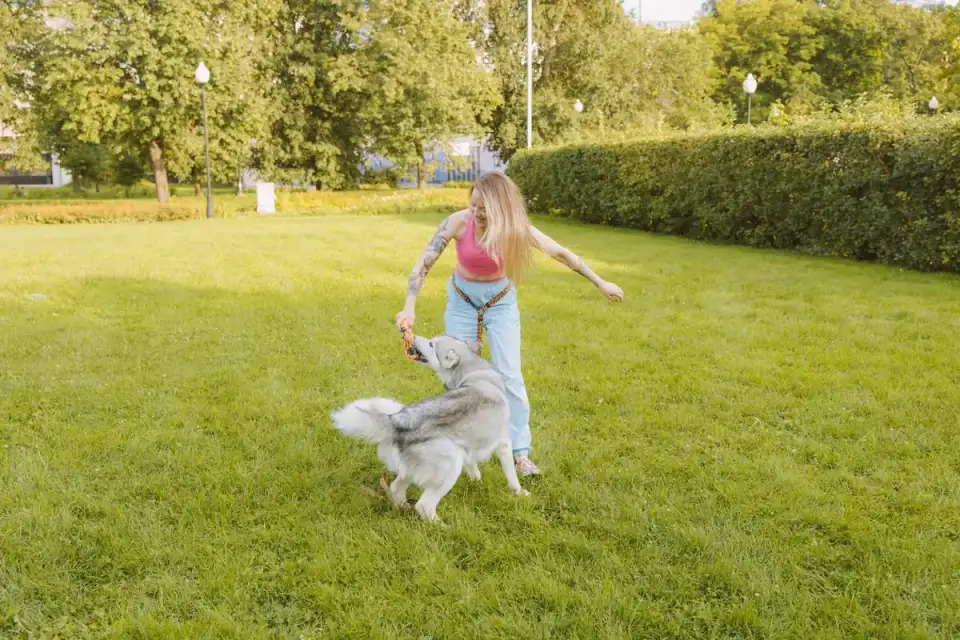
Toys and play are the most viable food substitute for the average pet dog, but they aren’t a universal swap. According to Preventive Vet, toy rewards let you reinforce from a distance in a way treats can’t — you can throw a ball to reward a dog mid-recall instead of waiting for them to return to your hand — which makes toys genuinely better than food for some behaviors, not just an equal substitute.
But drive isn’t universal. A University of Florida study found that nine out of ten dogs chose food over toys when given a direct choice, though the same research noted dogs can be trained successfully on toys if that preference is built early and deliberately — which is exactly how search-and-rescue and detection dogs are conditioned. Translation for a pet owner: if your dog is one of the nine, toy-only training is going to be slower and less reliable, especially anywhere distracting, and you should plan around that instead of forcing it.
Access rewards — the leash clip, the door opening, permission to greet a person — round out the toolkit. They’re free, they’re always available, and for a dog that’s motivated by getting somewhere or seeing someone, they can outperform both food and toys. The tradeoff is they only work for behaviors that happen near the thing being granted; they don’t travel well.
The client I still think about on this exact question
A client came in with a two-year-old Border Collie mix, high energy, food-motivated at home but essentially unreachable outside because a neighbor’s dog had once lunged at the fence line and the dog now scanned the street instead of working. She’d read that treats were “bribery” and switched her recall training to praise only, right around the time the reactivity started. Six weeks in, the recall had fallen apart — not because praise-only training is inherently wrong, but because she’d cut the value of the reward exactly when the environment got harder and the dog needed a stronger payoff, not a weaker one. We rebuilt the recall using a tennis ball she chased obsessively, moved to progressively higher-distraction sidewalks over about four weeks, and kept food in reserve for the hardest scenarios — the vet parking lot, the off-leash park entrance. The toy did the daily work. The food was there for the moments that actually mattered.
Where treat-free training genuinely wins, and where it quietly fails
It wins on convenience and health — dogs on strict weight management, dogs with food sensitivities, or dogs that get overexcited and grabby around food all do better with toy or play-based systems, and you skip the calorie math entirely. It also wins on distance work, since a thrown toy reaches a dog that a treat can’t.
It fails, or at least struggles, in two predictable spots: brand-new behaviors that need very fast, very frequent marking (a treat delivered in half a second beats a toy tug that takes three), and high-arousal or high-distraction settings where a weak reward gets outcompeted by the environment. That second one is where I see owners quit the treat-free approach entirely instead of just keeping food as backup for the hard days.
If you’re still deciding how to structure the sessions themselves, a clicker or a consistent verbal marker makes any of these reward types land more precisely, and the reward question sits inside the bigger picture covered in group classes vs. private vs. online training — the delivery format matters as much as the reward itself. Foundational cues like come when called and heel are also useful test cases: try building each one with a toy first, and only reach for food if the toy version stalls out.
My verdict
Training without treats is legitimate, not a downgrade, as long as you’re honest about what’s replacing the food and how strong that substitute actually is for your specific dog. Toys and play cover most pet dogs most of the time. Praise alone rarely carries a full training plan on its own. And keeping a stash of high-value food in reserve for the genuinely hard moments — vet visits, off-leash areas, reactive triggers — isn’t a failure of the treat-free method. It’s just matching the reward to the difficulty of the ask, which is the actual skill here, not the food itself.
Frequently asked questions
Is training with treats considered bribery?
Not when it's used correctly — a treat delivered after the behavior is a reward, not a bribe. Reward-based methods, food or otherwise, are the approach recommended by the AVSAB's humane training position statement.
Can praise alone train a dog?
For some dogs, in low-distraction settings, yes. For most dogs and most new behaviors, praise works far better paired with a toy or play than used by itself.
What's the best treat-free reward for a high-energy dog?
Toys and play tend to work best for high-drive, high-energy dogs, especially for behaviors that need to be rewarded at a distance, like recall.
Sources
- Position Statement on Humane Dog Training — American Veterinary Society of Animal Behavior
- How to Use Toys as Rewards in Dog Training — Preventive Vet