Arthritis vs. Normal Aging Stiffness in Dogs: How to Actually Tell
Arthritis versus normal aging stiffness in dogs comes down to one question — does the stiffness ease with movement or worsen?

On this page
Every few months a “senior dog glow-up” video makes the rounds — slow-mo of an old Lab suddenly bounding after a joint supplement is added to the bowl. The comments always split the same way: half “started mine on it too,” half “my vet said that’s just old age, don’t waste your money.” Both camps are half right, and the difference matters more than either side realizes.
I get some version of this question in nearly every senior wellness exam I run. The owner describes a dog who’s “just gotten old” — a little slower on walks, a little more careful with the stairs — and asks whether that’s something to treat or something to accept. My answer never starts with age. It starts with how the dog loads weight.
Here’s the fork: normal aging changes how willing a dog is to move. Osteoarthritis changes how the dog is physically able to move — the mechanics of the stride itself. That distinction is the whole article.
Watch the transition moments, not the dog at rest
A dog lying flat on the kitchen floor tells you almost nothing. Gait and joint disease reveal themselves at the transitions: standing up after a nap, the first ten steps out the door, turning a tight corner, going down stairs versus up them. Cornell University College of Veterinary Medicine: Cornell University’s Riney Canine Health Center notes that dogs with osteoarthritis are often slow to rise, particularly after extended rest, and may initiate the movement with the forelimbs before hoisting the hindquarters up in a distinct two-stage motion. That two-stage rise is a biomechanical workaround — the dog is redistributing load away from a joint that hurts, not just moving less enthusiastically.
Plain age-related slowing doesn’t usually produce a workaround. A dog that’s simply older gets up a beat slower across the board, evenly, and it doesn’t change day to day. A dog compensating for joint pain gets up unevenly, is worse on cold mornings or after a hard hike, and — this is the tell I lean on most — loosens up with about five to ten minutes of walking. Osteoarthritis pain classically improves somewhat with gentle movement and worsens again with rest. Simple deconditioning or age doesn’t follow that pattern; it stays flat regardless of activity.
The load-bearing clues that separate the two
Reasoning outward from gait mechanics, here’s the checklist I actually use during an exam, roughly in the order it becomes visible:
- Two-stage rising — front end first, hindquarters second, versus one smooth motion.
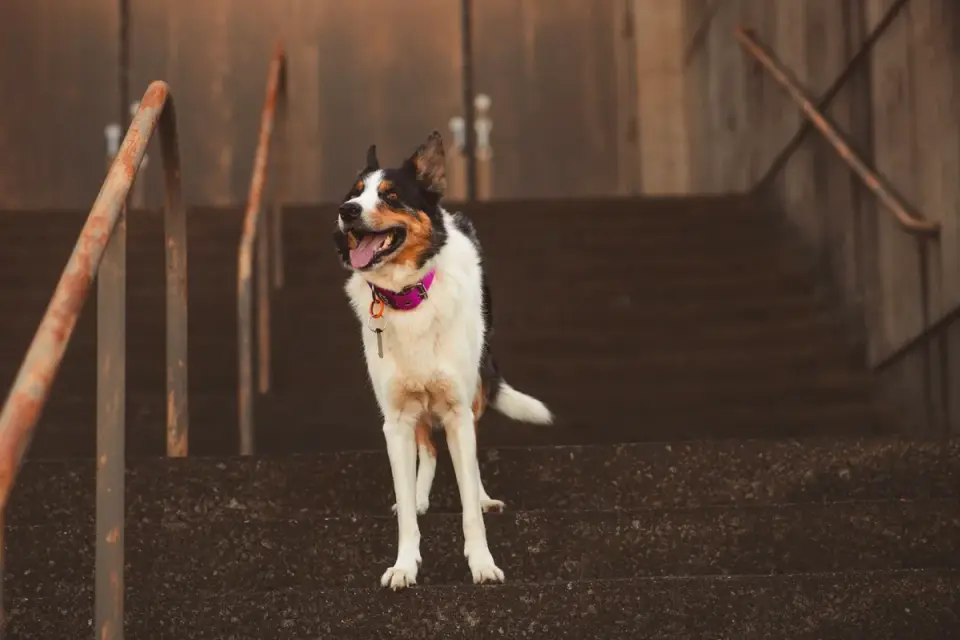
- Stair asymmetry — most arthritic dogs struggle with descent before ascent, because going down loads the front limbs and forces the hips and stifles to absorb impact.
- Reluctance to jump onto furniture or into the car, especially if it’s sudden rather than a gradual decline.
- Bunny-hopping or a truncal sway in the hind end, which suggests the dog is avoiding independent use of one or both rear limbs.
- Warm-up effect — stiff for the first several minutes, then visibly looser.
- Sitting crooked, with one hip rotated out or a leg held straight rather than tucked.
The Merck Veterinary Manual lists this same cluster — stiff gait, waddle or truncal sway, bunny-hopping, unwillingness to jump, and difficulty rising — as characteristic of canine osteoarthritis rather than incidental slowing. None of these are subtle once you know to look for them, but most owners never get pointed at them, which is exactly why underdiagnosis is such a persistent problem. AAHA reports that owner perception of subtle shifts in gait, mobility, and behavior is central to catching osteoarthritis early, and that studies screening general dog populations have found clinical signs consistent with OA in well over a third of dogs evaluated — many of them dogs whose owners had chalked the changes up to age.
One dog sticks with me: a nine-year-old Labrador, about 78 pounds, who came in because her owner noticed she’d stopped jumping onto the tailgate of the truck sometime that spring — she couldn’t pin down exactly when, just that it had been “a few months.” What made the case interesting wasn’t the tailgate; it was that the owner had almost cancelled the appointment because the dog still ran full-out chasing a ball in the backyard. On exam, that Lab had obvious bilateral hip discomfort on extension and the classic two-stage rise from a down position after sitting through the exam room paperwork. She ran fine because sustained forward motion doesn’t load the hip joint through the same range that jumping and rising do. That’s the biomechanics of it — a dog can look athletic in one plane of movement and still be in real pain in another, and owners understandably read “still runs like a puppy” as “not arthritic.” It’s one of the most common mismatches I see between what an owner reports and what the joints are actually doing.
Where this can still fool you — and when to get imaging
The honest counterargument here is that behavioral aging and OA overlap enough that a single home observation isn’t diagnostic. An anxious or simply cautious older dog can also hesitate at stairs; a dog with early cognitive decline can seem “slower” for reasons that have nothing to do with joints. That’s a fair pushback, and it’s why I don’t treat a checklist as a diagnosis. Cornell is direct about this: distinguishing normal aging from osteoarthritis reliably requires a physical exam and, in most cases, radiographs, because pain on palpation, joint effusion, crepitus, and reduced range of motion don’t always show up clearly on a living-room observation. Where I land, though, is that the movement-pattern checklist above is still the right first filter — it’s what tells you whether that vet visit is worth scheduling this month or can reasonably wait for the annual exam.
If your dog is also dealing with a sensitive stomach on car rides to the vet, it’s worth reading how ginger and chamomile compare for car sickness before that appointment, since a nauseated dog is a harder dog to examine accurately. And if the workup does confirm osteoarthritis, two follow-up questions come up almost immediately: what the long-term side effects of NSAIDs actually look like over months of use, and whether natural anti-inflammatory options have any real evidence behind them as an adjunct. Neither is a substitute for diagnosis, but both are reasonable next questions once you know what you’re dealing with.
The bottom line
I don’t tell owners to wait and see whether their dog “seems worse.” Waiting selects for a dog that’s already compensating hard by the time it becomes obvious, and joint disease is a lot easier to manage well before that point. My practical next step: film fifteen seconds of your dog rising from a lie-down and climbing down a full flight of stairs, on your phone, once a month. That single habit catches the two-stage rise and the stair asymmetry faster than memory ever will, and it gives your vet something concrete to compare instead of “he seems a little stiffer, maybe.”
Frequently asked questions
Can a dog have arthritis and still run normally?
Yes. Sustained forward motion like running doesn't load joints like the hips through the same range as jumping or rising from rest, so a dog can run well and still show clear discomfort getting up or climbing stairs.
Is stiffness that improves with movement a good or bad sign?
It's actually a classic osteoarthritis pattern — pain that eases somewhat with gentle warm-up movement and returns with rest points toward joint disease rather than simple age-related slowing, which tends to stay flat regardless of activity.
How is osteoarthritis actually confirmed in dogs?
Home observation is a useful first filter, but a definitive answer requires a veterinary physical exam — checking for pain on palpation, joint effusion, crepitus, and reduced range of motion — plus radiographs in most cases.
Sources
- Osteoarthritis — Cornell University College of Veterinary Medicine
- Osteoarthritis in Dogs and Cats - Musculoskeletal System — Merck Veterinary Manual
- Canine osteoarthritis: An underdiagnosed condition — AAHA