
Tuesday night, your senior Lab mix stops dead at the top of the basement stairs. Tail tucked, nails clicking, weight shifted backward. You coax, you lift, you feel guilty. By morning she will not even cross the kitchen tile to eat.
That is the fork every owner hits with stairs and slippery floors: is this stubbornness I should push through, or is this information I should respect and work around? As an oncologist who weaves supportive care into whole-patient medicine, I land firmly on the second. Fear on stairs or slick surfaces may help support a larger conversation about comfort and function, never as a diagnosis by itself.
The first passage that makes it concrete looked like this. A nine-year-old, 68-pound retriever blend who had cruised stairs for years began pausing, sniffing the edge, then backing away. Her owner assumed aging stubbornness. Three weeks in, the pattern sharpened: she would do carpeted steps but not hardwood, would go up but not down, and by day 10 of keeping a log, the owner noticed a stiff rise after naps and a scuffed toenail from a slip. That detail changed the plan from training to examination first.
So is it fear, footing, or something hurting?
Most dogs are not scared of stairs as an idea. They are scared of what happened on them.
Slipping is powerful learning. One splay on varnished wood teaches a dog that tile equals no control. Depth perception matters too, especially on open-backed stairs or glossy floors with reflections. Noise, narrow turns, and poor lighting add load. And pain changes the math completely — elbow arthritis, hip discomfort, neck pain, a torn nail, or neurologic wobbliness can make descending feel unsafe even when the dog wants to follow you.
I do not try to sort this by vibe. I start from the exam, not the assumption. Watch: does the dog hesitate only going down? Pant or lip-lick at the edge? Bunny-hop, slip, splay, or sit and refuse? Is it worse in the morning, after play, or on wet paws? Those observations help your veterinarian localize discomfort versus pure anxiety, and they keep supplements in their proper place as things that may help support calm, not fixes for pain.
For context on how I think about calming support in general, I often point owners to Dog Calming Chews: What the Ingredients and Doses Actually Tell You and the broader Dog Anxiety Supplements: The Ingredient Checklist Worth Trusting. Both walk through why named actives and real doses matter more than a cute label.
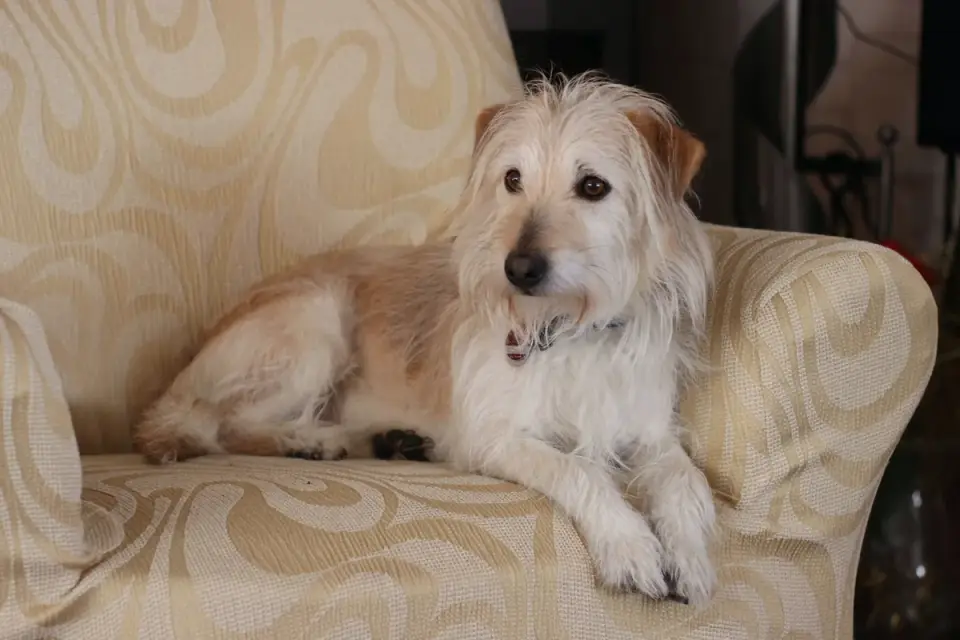
The TikTok rug-runner fix almost worked — until it didn’t
The second story is the tradeoff. A four-year-old, 42-pound cattle dog mix panicked on laminate after moving to a new apartment. The owner did what social media suggested: bought runners, laid yoga mats, lured with cheese. For two weeks it looked like a win.
Then the failure point showed. By day 14 the dog would sprint the runner path but froze if a mat shifted even six inches, and started refusing the hallway entirely when the washer buzzed. The runners helped footing but did not address sound sensitivity and the lack of a trained exit strategy. The owner had built a narrow bridge with no guardrails.
This is where my integrative lens stays bounded. Calming herbs and amino acids that trend for anxiety deserve honest framing. Chamomile is a good example. A review summarized in MDPI notes that “For the remaining species, evidence is derived mainly from preclinical studies or traditional use.” That does not dismiss traditional use; it means I frame chamomile around comfort and routine, not as a cure for phobia. Similarly, ashwagandha talk needs limits. A review summarized in Cureus found that “A systematic review analyzed multiple RCTs and concluded that ashwagandha has a moderate positive impact on stress reduction and cognitive performance.” That is general evidence, not proof it will carry a dog downstairs. And for L-theanine, often cited for calm, a review summarized in Nature Portfolio describes “except for one study on psychotic anxiety (SMD = 0.54; 400 mg/day for 8 weeks)” — a human dose context that should not be extrapolated to dogs.
The strongest counterargument I hear is fair: why not just use a calming supplement and keep luring? Because if pain or panic is driving avoidance, masking arousal without changing footing and training can leave the dog more willing to attempt something that still hurts.
What actually rebuilds confidence on stairs and slick floors
Start with medical clearance. Limping, stiffness, knuckling, head tilt, recent fall, sudden change in an older dog, or fear paired with house-soiling, appetite change, or nighttime restlessness warrants an exam promptly. Do not carry a large dog repeatedly if you can avoid it; a bad lift injures both of you.
Then change physics before psychology. Add secure traction — anchored runners, stair treads, non-slip mats with rubber backing. Trim nails and interdigital hair, keep paw pads dry, improve lighting, add a baby gate so the dog is not forced to navigate stairs to meet basic needs. For arthritic dogs, ramps with a gentle incline and side rails often beat stairs entirely.
Then retrain in small slices. Reward looking toward the stairs, one paw on textured surface, one step and exit. Keep sessions under three minutes. End while the dog is still willing.
This is the edge case that reframes everything. A seven-year-old, 55-pound spaniel mix handled stairs perfectly at home but froze on polished veterinary floors and parking garages. By week five the owner realized the trigger was not height but glare and echo plus the smell of disinfectant. We shifted the goal from stair drills to surface generalization: different textures in daylight, quiet lobbies first, then busier ones, with food therapy principles used simply as consistent, gentle nutrition and routine to support overall comfort. The dog did not need braver stairs. She needed a wider definition of safe ground.
If storms or clinic visits stack onto floor fear, layered plans help. See How to Calm a Dog During Thunderstorms: A Layered Plan That Actually Holds Up for how environment, training, and veterinary guidance fit together without overreaching.
My verdict is simple. Respect the refusal, rule out pain, fix traction, then teach. Supplements that may help support relaxation can sit alongside that work, never in front of it.
Frequently asked questions
Should I force my dog to use the stairs if she is scared?
No. Avoid forcing, carrying on slippery steps, or repeated luring when the dog is panicking. Rule out pain first, add traction and lighting, then retrain one step at a time with short, positive sessions.
Do rugs and stair treads really help?
Yes for many dogs because slipping drives much of the fear. Use anchored runners and non-slip treads, trim nails, and consider a ramp for seniors or arthritic dogs.
When should I call the vet?
Call promptly for sudden fear, limping, stiffness after rest, yelping on stairs, knuckling, falls, or fear paired with appetite, bowel, or behavior changes.
Sources
- Chamomile Evidence in Biomedicines Review — MDPI
- Ashwagandha Systematic Review — Cureus
- L-Theanine Review in Molecular Psychiatry — Nature Portfolio