Why Does My Dog Yawn and Lick His Lips Around Strangers?
Medically reviewed by Joyce Gerardi, DVM, CVA, CVCH, CVFT, MSTCVM — For general education — not a substitute for veterinary care.
Dogs often yawn and lick their lips around strangers as a calming signal to ease social tension.

On this page
Dogs often yawn and lick their lips around strangers as a calming signal to ease social tension. If your dog does this every time a delivery driver, houseguest, or new dog approaches, start by treating it as information, not a quirk to ignore.
What Yawning and Lip-Licking Actually Mean
In dog body language, a yawn or a lip-lick that shows up outside of mealtime or waking from a nap is usually what trainers call a calming signal — a self-soothing behavior a dog uses to lower its own arousal, and sometimes to signal to the other party that it isn’t looking for a fight. Think of it as the canine version of a shaky laugh or a shoulder shrug in an awkward conversation. It’s not obedience-school misbehavior, and it isn’t the dog being “rude” to your guest. It’s stress leaking out through the easiest available channel.
The behavior tends to cluster with strangers specifically because novelty is one of the most common stress triggers for dogs. A new person carries an unfamiliar scent, voice, posture, and often moves in ways your dog can’t predict yet. Until the dog gets more information — through sniffing, watching, or simply time — its nervous system stays a notch elevated, and that low hum of arousal is what produces the yawning and licking.
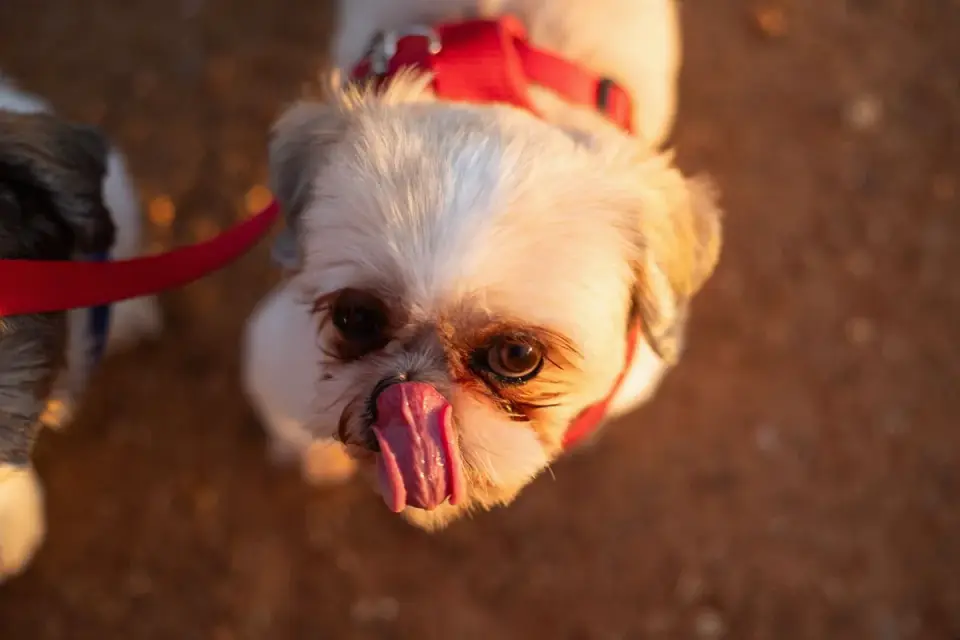
Calming Signal vs. Everything Else It Could Be
Before you label every yawn a stress signal, run through the alternatives, because the same behavior can have several causes and the fix is different for each one.
A sleepy yawn shows up alongside slow blinking, a relaxed body, and usually happens when nothing new is going on. A stress yawn shows up at the exact moment a stranger enters the room, often paired with a closed mouth, a lowered head, or a tail that drops or tucks. Lip-licking tied to food is quick, single, and stops the second the food is gone or out of sight; lip-licking tied to stress repeats, sometimes with visible saliva, and continues well after there’s nothing to lick up. A third possibility — nausea or dental discomfort — produces lip-licking with no social trigger at all, including when the dog is alone.
The cleanest way to sort these out is to watch the rest of the body at the same moment the mouth moves. A stressed dog around a stranger usually shows at least one more sign: ears pinned back or held stiffly forward, a tail carried low or tucked, weight shifted backward or away from the person, or “whale eye” — the whites of the eyes showing as the dog watches the visitor sideways without turning its head. One signal alone is a data point. Two or three together are a pattern worth acting on.
What to Do When You See It
Give the dog room to opt out of the greeting rather than steering it toward the stranger. Let your dog choose the distance; dragging a hesitant dog closer to “say hi” only confirms that its early warning signals get overridden, which tends to make the next warning sharper. Ask visitors to ignore the dog on arrival — no direct eye contact, no leaning over, no reaching for the head — and let the dog approach if and when it wants to. If you have a moment before guests arrive, a short walk or a few minutes of a familiar activity can take the edge off baseline arousal so a new face doesn’t land on top of an already keyed-up dog.
For dogs whose stranger-anxiety shows up often enough to be a pattern rather than a one-off, some owners look at situational-stress support alongside training. Biomedicines: Chamomile has a long history in traditional herbal care for relaxation, though current evidence in most species, including dogs, is still derived mainly from preclinical studies and traditional use rather than large clinical trials. Human research on Cureus: KSM-66 ashwagandha is further along — a systematic review of multiple randomized controlled trials found a moderate positive impact on stress reduction and cognitive performance — though that data comes from human studies, not dogs. Molecular Psychiatry: L-theanine has similarly been studied mostly in people, with one trial on psychotic anxiety showing a moderate effect at 400 mg/day over eight weeks. None of these ingredients are a stand-in for management or training; they’re a smaller piece that only makes sense situated inside the whole dog’s picture, alongside how the household handles greetings and how much the dog is being asked to tolerate before it’s ready.
A short paragraph is worth its own line here: no supplement fixes a greeting that’s still moving faster than the dog wants it to.
If you’re trying to sort a persistent stress pattern from a genuine medical issue, our guide on signs your dog needs a calming supplement walks through the behavioral checklist a vet actually uses. And if chamomile keeps coming up in your research, the head-to-head breakdown in Chamomile vs L-Tryptophan for Calming Dogs goes deeper into how the two compare.
When It’s More Than Just Nerves
Call your vet if the lip-licking happens constantly, with no social trigger, or comes with drooling, gulping, or a reluctance to eat — those point toward nausea or dental pain rather than a social response. Also flag it if the yawning-and-licking pattern around strangers escalates over weeks into stiffening, growling, or snapping; that trajectory usually needs a trainer or veterinary behaviorist involved before it becomes a bigger safety issue, not a supplement.
The practical next step is simple: the next time a stranger walks in, watch your dog’s whole body for five seconds before you decide what the yawn means, and let that read guide how much space you give the greeting.
Frequently asked questions
Is yawning around strangers always about stress?
Mostly, but not exclusively. A dog can yawn because it's genuinely sleepy or transitioning between activities. The context that points to stress is a yawn paired with other body-language shifts — a lowered head, a tucked tail, or a stiff stance — right as a new person approaches.
Should I correct my dog for lip-licking at a visitor?
No. Correcting a calming signal removes the dog's way of communicating discomfort without teaching it anything new, and it can push the dog toward a more direct warning like a growl or snap the next time. Manage the greeting instead.