How to Use a Training Treat Pouch Effectively
How you use a training treat pouch determines whether your dog links behavior to reward within seconds.

On this page
How you use a training treat pouch determines whether your dog links behavior to reward within seconds. That window is not a minor detail — it is the whole mechanism. Reward-based learning depends on the dog’s brain pairing an action with a consequence closely enough in time that the two feel connected, and a pouch exists to protect that timing against fumbling pockets, sealed bags, and slow hands.
Before the session: loading the pouch
Load the pouch before your dog is anywhere near the training area, not after you have already asked for a sit. Cut treats down to pea-sized pieces or smaller — small enough to swallow in one motion so your dog’s attention snaps right back to you instead of settling in to chew. Pick treats your dog will work for on that particular day, since motivation shifts with distraction level, hunger, and novelty.
Wear the pouch in the same spot every time, whether that is front-and-center or clipped to your hip. Muscle memory around where your hand goes matters more than which side you choose. According to the American Veterinary Society of Animal Behavior (AVSAB), reward-based methods outperform aversive tools on both training effectiveness and the welfare of the dog, and a pouch is simply infrastructure for doing reward-based training well.
A loaded, accessible pouch is the difference between a planned session and an improvised one.
During the session: marking and delivering
The pouch only helps if the hand-to-mouth trip is fast. Open the flap, or use a pouch style that stays open, so you are not digging while your dog waits. A verbal marker — a short, consistent word like “yes” — or a clicker bridges any unavoidable delay by telling the dog exactly which instant earned the reward, even if the treat itself arrives a beat later.
Deliver the treat close to your dog’s mouth rather than making them stretch or chase it, and reward from the hand nearest wherever the behavior happened (at your side for heel work, in front for a stationary sit). Humane World for Animals frames this kind of reward-based training as reinforcing the behavior you want while removing reinforcement from the behavior you do not, and a treat pouch is what makes that removal-and-reward pattern practical in real time rather than theoretical.
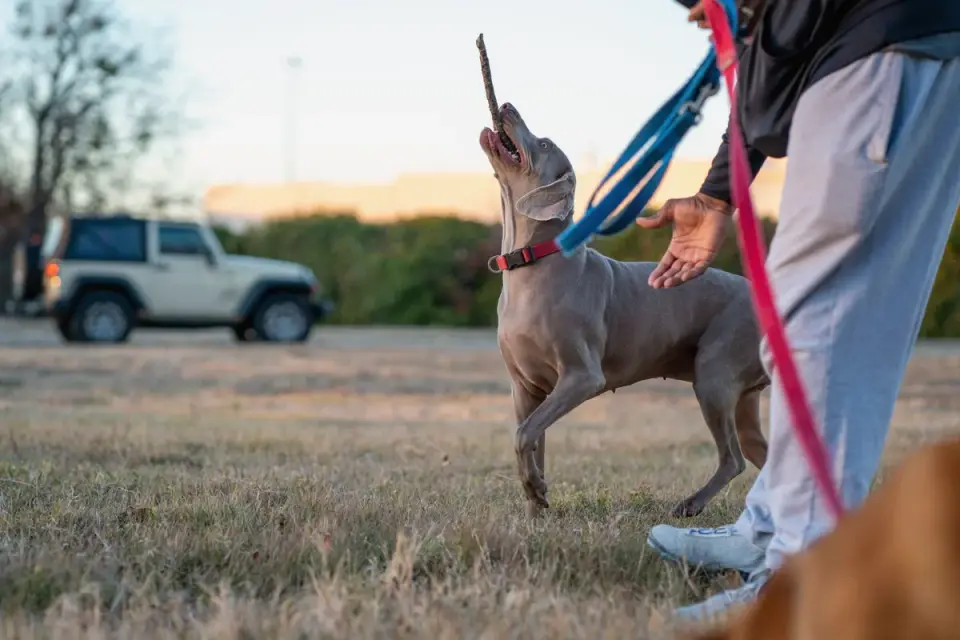
Sessions run smoother when the pouch stays within reach the entire time — clipped on, not set down on a bench between reps.
Between behaviors: managing volume and distraction
Treats add up fast across a session, so portion planning matters as much as pouch mechanics. If you are working with commercial training treats or chews, check what a serving actually looks like rather than eyeballing it, especially with dogs already on a fiber- or calorie-controlled diet; our piece on whether a dog can get too much fiber covers how treat volume can quietly upset a dog’s gut over a long day of repetitions.
Buying treats specifically for pouch use in bulk is common, and cost per serving genuinely differs by bag size — we broke down whether a bigger bag of chews costs less per serving if you are stocking a pouch weekly rather than per session.
After the session: fading and maintaining the habit
Once a behavior is reliable on cue, start thinning the ratio of treats to repetitions rather than dropping the pouch cold. Reward every other correct response, then every third, keeping the marker word consistent even as the treat itself becomes intermittent. This is standard operant conditioning practice, not a shortcut — pulling reinforcement too fast is one of the more common reasons a previously solid behavior falls apart at the exact moment you stop carrying the pouch.
Keep the pouch itself clean and treat-residue-free between uses; leftover crumbs attract ants and go rancid faster than most owners expect, especially with soft, high-value treats.
Common mistakes worth naming
A few habits quietly undo the timing advantage a pouch is supposed to give you. Fumbling with a zipper instead of a magnetic or roll-top closure adds seconds you cannot get back. Overfilling the pouch with large treats slows down delivery and pads calories unnecessarily. And training with the pouch only some of the time, so your dog associates the reward with the accessory rather than the behavior, undercuts the whole point.
If your dog’s overall diet already leans toward chews or functional treats, it is worth knowing what is actually in them; our guide to choosing a probiotic for dogs walks through label-reading that applies just as well to anything you are loading into a pouch by the handful.
In short, a treat pouch is a timing device dressed up as a snack bag. Load it ahead of time, keep delivery fast and close to the mouth, mark the moment rather than the outcome, and fade it deliberately once the behavior sticks. Get those four steps right and the pouch stops being a convenience and starts being the reason the training actually works.
Frequently asked questions
Which side should the treat pouch sit on?
Either side works as long as it stays in the same spot every session. Consistent placement means your hand goes there automatically, which shaves fractions of a second off delivery — the part of training that actually matters.
How many treats should go in the pouch per session?
Enough for the session length, cut small enough that calories do not add up. Pea-sized pieces let you reward more repetitions without your dog filling up or losing interest halfway through.
Sources
- Position Statement on Humane Dog Training — American Veterinary Society of Animal Behavior (AVSAB)
- How to Reward Dogs With Positive Reinforcement Training — Humane World for Animals