Chew vs Powder vs Liquid Dog Supplements: Which Form Actually Works?
Whether a supplement comes as a chew, powder, or liquid matters less than whether the label's dose survives digestion.

On this page
A twelve-year-old Labrador named Otis showed up in my exam room three years ago because his owner couldn’t get him to finish his joint chews anymore. He’d take a bite, spit it out, and walk away — a dog who used to inhale everything from socks to string cheese. His owner had spent months on a chew that TikTok kept recommending, only to realize the arthritis symptoms she was tracking (slower on stairs, reluctant to jump into the car) hadn’t budged in that whole stretch. We switched him to a powder mixed into his food, and within a few weeks she noticed he was finishing every dose — which, it turns out, is most of the battle.
That’s the real question buried under every “which supplement form is best” video: does your dog actually swallow the labeled dose, and does that dose survive digestion intact? Chew, powder, and liquid formats each answer that differently, and the honest answer is that none of them wins across the board.
Chews: high compliance, more variables to control
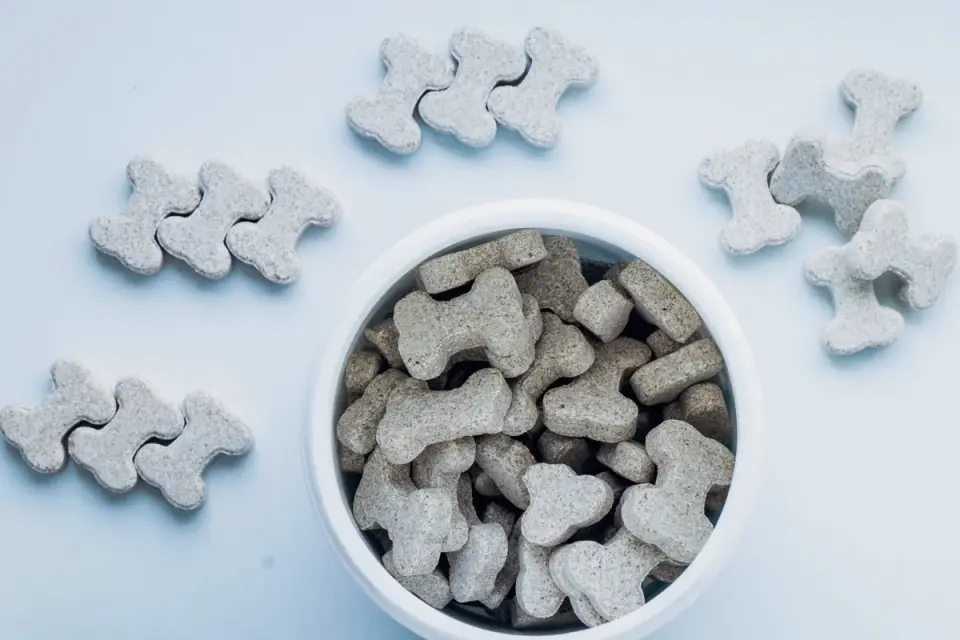
Soft chews are popular because dogs generally treat them like food, not medicine — palatability is baked in with flavorings, oils, and binders. That’s a real advantage for compliance, especially with picky or anxious eaters. The tradeoff is that those same binders, moisture, and processing steps can affect how completely the active ingredients dissolve and get absorbed in the gut, and there’s comparatively little published data pinning down exactly how much that matters ingredient by ingredient. A chew is also easy to overdose or underdose if a dog only eats half of it — something I see constantly with joint chews left half-chewed on the kitchen floor.
Powders: closer to lab conditions, less forgiving on labeling
Powders mixed into food tend to preserve more of the raw ingredient without extra processing, and they let owners scale the dose precisely by weight — useful for a 9-pound Chihuahua and a 90-pound Mastiff on the same product line. The catch is that a powder is only as good as its measuring scoop and the owner’s consistency; skipped scoops or eyeballed servings undercut dosing accuracy in a way a pre-portioned chew doesn’t. This is part of why third-party oversight matters: the PetMD: National Animal Supplement Council requires member companies to submit to independent lab testing verifying that what’s on the label is actually in the product — a basic quality floor that applies regardless of format.
Liquids: fastest absorption, shortest shelf tolerance
Liquids are already dissolved, which generally means less digestive breakdown standing between the dose and the bloodstream — the NIH Office of Dietary Supplements notes that bioavailability, not just label dose, is what determines whether a supplement actually reaches circulation, and formulation is one of the variables that shapes that. In a head-to-head pharmacokinetic comparison of glucosamine and chondroitin formulations, researchers found the dose-normalized peak plasma glucosamine concentration was higher for the liquid formulation than for either tablet form tested, even though overall absorbed fraction was broadly similar once results were normalized to the administered dose. Liquids come with their own downsides, though: they spoil faster once opened, many dogs resist the taste more than a flavored chew, and they’re messier to dose accurately without a syringe.
I’ve watched this play out with an eleven-year-old dachshund whose owner insisted on a liquid glucosamine product because a video claimed it worked “instantly.” The dog hated the taste, started associating mealtime with being cornered for a dropper, and stopped eating his regular food within two weeks. We moved him to a chew, his appetite recovered, and — more relevant to the joint question — he actually got a consistent dose again. Read the data closely before crowning any one format, because the pharmacokinetics only matter if the dog swallows the product in the first place.
Where the evidence actually lands
None of this is a case for ignoring formulation. A PMC (NCBI): randomized, block-controlled trial in dogs with hip osteoarthritis found real functional improvement with glucosamine/chondroitin and marine fatty acid compounds — but that trial used a specific, dosed formulation, not a category-wide guarantee that any chew, powder, or liquid works equally well. The lesson isn’t “buy the liquid because it’s more bioavailable in a lab.” It’s that bioavailability data has to be paired with a format your specific dog will actually take, every day, at the labeled amount.
For a dog with a sensitive stomach or reflux, or one recovering from GI upset, I’ll often lean toward a powder mixed thoroughly into a bland diet — it’s gentler and easier to titrate down if needed. For a dog who’s a notoriously picky chewer but tolerates dry food fine, a well-formulated chew usually wins on real-world compliance even if it isn’t the fastest-absorbing option on paper. If you’re also weighing gut-health products in these formats, it’s worth applying the same logic used when comparing prescription veterinary probiotics to over-the-counter versions — strain and dose documentation matter more than the delivery vehicle’s marketing.
The bottom line
Chews win on compliance and ease. Powders win on dosing precision and ingredient integrity, if the owner is consistent. Liquids win on raw absorption speed but lose on palatability and shelf stability for a lot of dogs. The format that actually helps your dog is the one whose label dose it will reliably finish, not the one that trended this week. So which one is that for your dog — the one they’ll eat, or the one the pharmacokinetics favor? Usually, if you’re honest about your dog’s habits, that’s not actually a hard question.
For related context, read Ginger vs. Chamomile for Dog Car Sickness: Which One Actually Belongs in the Glovebox.
Frequently asked questions
Is liquid glucosamine really absorbed faster than chews for dogs?
In head-to-head pharmacokinetic testing, the dose-normalized peak plasma glucosamine level was higher for a liquid formulation than for tablet forms, though overall absorbed fraction was broadly similar once normalized to dose — so liquid has a real edge in speed, but not necessarily total uptake.
Does the NASC seal mean a supplement works?
No. The National Animal Supplement Council seal certifies that a company follows quality-control, labeling, and independent testing standards so the label matches what's in the product — it does not certify that the product produces a specific health outcome.
My dog won't eat a chew or take a liquid — what should I try?
A powder mixed thoroughly into regular food is usually the easiest format to hide from a picky eater, provided you measure the scoop consistently rather than eyeballing it.
Sources
- What is NASC? (National Animal Supplement Council) | PetMD — PetMD
- Dietary Supplements: What You Need to Know — NIH Office of Dietary Supplements
- Study of the effectiveness of glucosamine and chondroitin sulfate, marine based fatty acid compounds, and carprofen for the treatment of dogs with hip osteoarthritis — PMC (NCBI)